Hitch Cargo Carrier Weight Limits Explained
Key Takeaways
- Most hitch cargo carriers are rated for 400–500 lbs, but your actual limit depends on your vehicle's tongue weight capacity, not just the carrier's rating.
- Class III hitches support up to 500 lbs tongue weight, while Class II hitches max out at 300 lbs — always check your hitch class first.
- Weight placed on a hitch cargo carrier acts as a lever, meaning 300 lbs of cargo can exert significantly more stress on the hitch than 300 lbs in the truck bed.
- Exceeding your hitch cargo carrier's weight limit can cause dangerous rear sag, reduced steering control, and accelerated hitch receiver wear.
- Distributing weight evenly and keeping heavy items centered on the carrier platform are the two most important loading practices for safe hauling.
How Much Weight Can a Hitch Cargo Carrier Actually Hold?
Most hitch-mounted cargo carriers are rated between 400 and 500 lbs, with 500 lbs being the most common manufacturer rating for standard steel and aluminum models. However, your actual carrying capacity is determined by the lowest-rated component in your setup — not the carrier alone.
Three weight ratings interact to determine your true limit:
- Carrier platform rating: The maximum load the carrier structure itself can support, typically 400–500 lbs for consumer models
- Hitch receiver tongue weight rating: How much downward force your hitch receiver can handle, which varies by hitch class
- Vehicle manufacturer's tongue weight limit: The maximum rear-point load your vehicle frame and suspension are designed for
Your safe carrying capacity is always the lowest of these three numbers. A carrier rated for 500 lbs does you no good if your vehicle's hitch is only rated for 200 lbs of tongue weight.
For example, if you have a 500 lb carrier, a Class III hitch rated for 500 lbs tongue weight, and a vehicle manufacturer rating of 350 lbs, your actual safe limit is 350 lbs. Always check your owner's manual for the vehicle-specific number — it's the one most people overlook.
Budget-friendly options like the MaxxHaul 70107 Steel Cargo Carrier and the WEIZE Folding Cargo Carrier Basket both carry a standard 500 lb rating, which is sufficient for the vast majority of hauling needs when paired with the right hitch class.
What Hitch Class Do You Need for a Cargo Carrier?
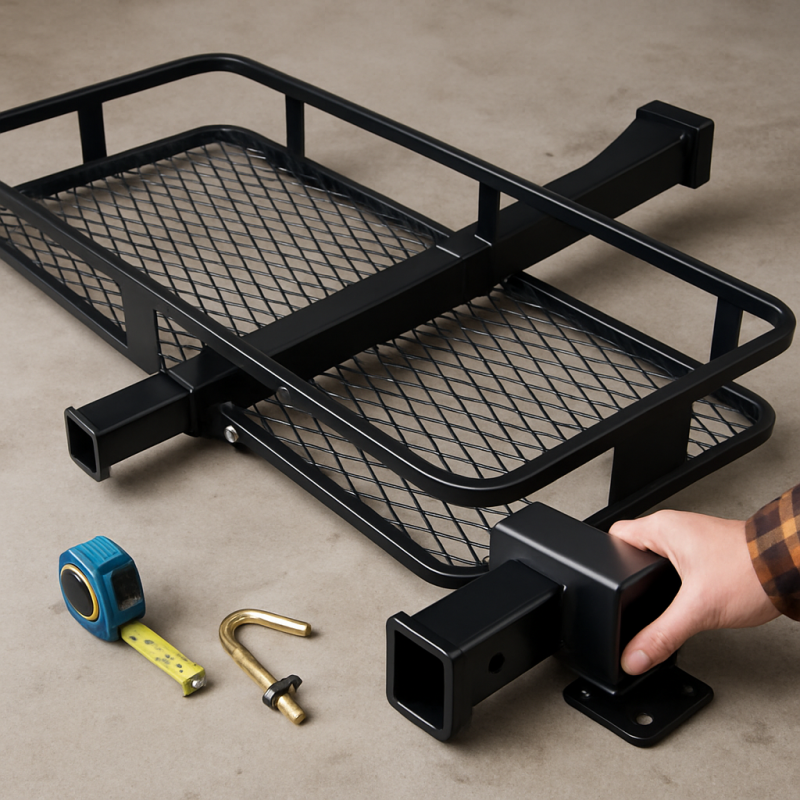
Your hitch class is the single biggest factor in determining how much weight your cargo carrier can safely hold. Hitch classes are standardized by the Society of Automotive Engineers (SAE J684), and each class has a specific tongue weight limit that directly caps your cargo carrier capacity.
Here's how each hitch class breaks down for cargo carrier use:
| Hitch Class | Receiver Size | Max Tongue Weight | Cargo Carrier Compatible? |
|---|---|---|---|
| Class I | 1.25" | 100–200 lbs | Very limited — light items only |
| Class II | 1.25" | 200–350 lbs | Yes, with weight restrictions |
| Class III | 2" | 350–500 lbs | Yes — most common for carriers |
| Class IV | 2" | 500–750 lbs | Yes — full carrier capacity |
| Class V | 2.5" | 750–1,200 lbs | Yes — heavy-duty hauling |
Most hitch cargo carriers require a 2-inch receiver, which means you need at least a Class III hitch to use them. If your vehicle only has a Class I or II hitch with a 1.25-inch receiver, you'll need an adapter — but adapters reduce your effective weight capacity even further.
- Class III is the sweet spot for most truck and SUV owners — it handles the full 500 lb carrier rating
- Class I and II hitches are common on sedans and crossovers and severely limit what you can carry
- Class IV and V hitches give you headroom above the carrier's own rating, so the carrier becomes the limiting factor
If you don't yet have a hitch installed, check out our guide on how to install a trailer hitch — proper installation is critical for safe cargo carrier use. You can also browse our roundup of the best trailer hitches for trucks to find the right class for your vehicle.
Why Does Tongue Weight Matter More Than Carrier Rating?
Tongue weight matters more than carrier rating because a hitch cargo carrier creates a lever effect that amplifies the force on your hitch receiver. The cargo sits behind the rear axle, and physics dictates that weight placed further from the axle exerts greater downward — and upward — forces on your vehicle's frame.
Here's what actually happens when you load a hitch cargo carrier:
- Rear axle overload: Weight behind the axle pushes the rear suspension down, potentially exceeding your rear axle weight rating (RAWR)
- Front axle unloading: As the rear drops, the front of the vehicle lifts slightly, reducing front tire contact and compromising steering response
- Hitch receiver stress: The cantilever effect means 400 lbs of cargo at 24 inches behind the receiver creates more shear force than 400 lbs sitting directly on the axle
According to Curt Manufacturing's tongue weight guidelines, exceeding your tongue weight capacity by even 10–15% can noticeably affect vehicle handling, particularly at highway speeds and during emergency braking.
The practical impact is significant. A fully loaded 500 lb carrier can cause:
- 1–3 inches of rear sag on half-ton trucks
- Headlight aim shift — your low beams point upward, blinding oncoming traffic
- Reduced braking performance — less weight on front tires means longer stopping distances
- Trailer sway amplification — if you're also towing, the problem compounds dramatically
This is why your vehicle's tongue weight rating — not the carrier's advertised capacity — is the number you should plan around. Check your owner's manual or the sticker on your hitch receiver for this specification.
Does Carrier Material Affect Weight Capacity?
Carrier material affects the carrier's own weight far more than its load capacity. Both steel and aluminum carriers commonly share the same 500 lb load rating, but the carrier's self-weight counts toward your tongue weight limit — and that's where material choice makes a real difference.
Here's how the two main materials compare:
| Feature | Steel Carriers | Aluminum Carriers |
|---|---|---|
| Typical Load Rating | 500 lbs | 500 lbs |
| Carrier Self-Weight | 40–65 lbs | 25–35 lbs |
| Rust Resistance | Moderate (needs coating) | Excellent (naturally resistant) |
| Price Range | $80–$150 | $120–$200 |
| Durability | Higher impact resistance | Lighter but can bend under overload |
The weight difference matters. A steel carrier weighing 55 lbs leaves you with 445 lbs of actual cargo capacity on a 500 lb tongue weight limit. An aluminum carrier at 30 lbs gives you 470 lbs of usable capacity — an extra 25 lbs you can put toward gear.
- Steel carriers are more affordable and resist bending better, making them ideal for heavy, compact loads like toolboxes and coolers
- Aluminum carriers are worth the premium if you're close to your tongue weight limit or want easier installation and removal
The MaxxHaul 70108 Aluminum Cargo Carrier is a solid example of an aluminum option that maintains the full 500 lb rating while keeping self-weight manageable. For a budget steel option, the WEIZE 53" x 19" Steel Cargo Carrier bundles a stabilizer, waterproof bag, and net at a competitive price.
If you're comparing carrier types more broadly — including rooftop options — our hitch cargo carrier vs rooftop cargo box comparison breaks down the pros and cons of each approach.
MaxxHaul 70108 Aluminum Cargo Carrier with High Side Rails
Lightweight aluminum construction saves 15–25 lbs over steel carriers, maximizing your usable cargo capacity while maintaining a full 500 lb load rating.
Check Price On AmazonIf you click this link and buy, we earn a commission at no additional cost to you.

What Happens If You Overload a Hitch Cargo Carrier?
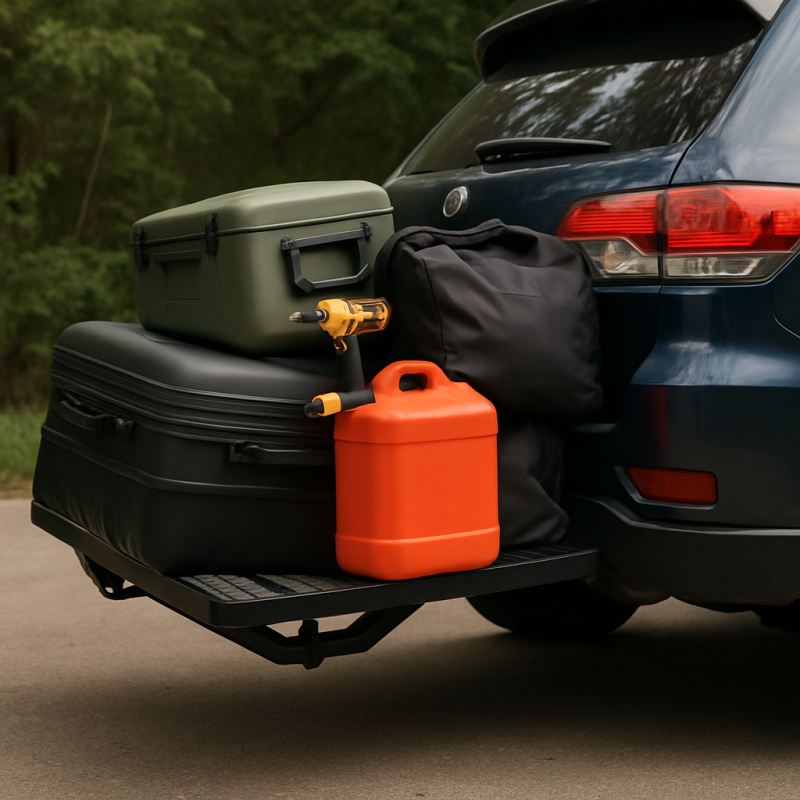
Overloading a hitch cargo carrier creates a cascading series of problems that start with mild inconvenience and can escalate to dangerous vehicle handling failures. The consequences range from cosmetic hitch damage to loss of vehicle control at highway speeds.
Here's what overloading actually does to your setup:
- Hitch receiver deformation: The receiver tube can bend or warp, making it impossible to remove the carrier or insert other hitch accessories
- Carrier platform failure: Welds can crack, side rails can separate, and the mesh or solid platform can buckle — potentially dumping your cargo on the road
- Rear suspension bottoming out: Exceeding the rear axle weight rating compresses shocks and springs to their limits, causing harsh ride quality and potential spring breakage
- Accelerated tire wear: Uneven weight distribution causes rear tires to wear faster on the inner edges
The handling consequences are the most dangerous:
- Reduced front-end grip: Front tires lose contact pressure, increasing stopping distances by 15–25% in some cases
- Increased sway: Rear-heavy vehicles are more susceptible to crosswinds and lane-change instability
- Hitch pin failure: The clevis pin or hitch pin can shear under excessive cantilever force, causing the entire carrier to detach
The NHTSA's trailer safety guidelines emphasize that overloaded rear-mounted equipment is a contributing factor in loss-of-control crashes, particularly on wet roads. If your vehicle's rear is sagging noticeably when loaded, you've likely exceeded a safe limit — even if you're technically under the carrier's rated capacity.
A quick self-check: if your headlights are pointing upward after loading, your rear has dropped too far. Unload some weight before driving.
OKLEAD 500 Lbs Heavy Duty Hitch Mount Cargo Carrier
Extra-large 60" x 24" platform with 14.4-inch high side rails makes this ideal for bulky camping gear and oversized loads that need lateral containment.
Check Price On AmazonIf you click this link and buy, we earn a commission at no additional cost to you.
How Should You Distribute Weight on a Cargo Carrier?
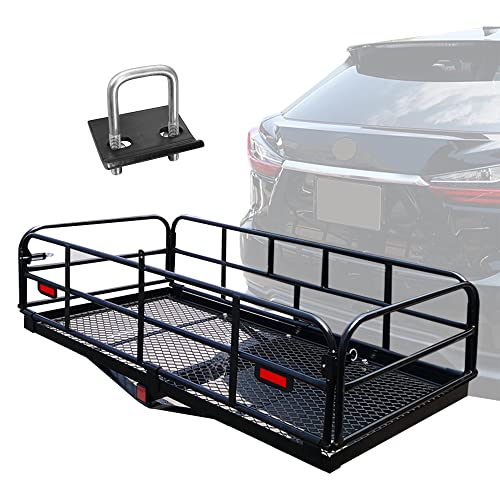
Proper weight distribution means placing heavy items centered on the platform and as close to the vehicle as possible. The further weight sits from the hitch receiver, the greater the lever effect on your vehicle's rear end — even a small shift can make a measurable difference in handling.
Follow these loading best practices:
- Center heavy items side-to-side: Offset loads cause lateral sway and uneven tire loading
- Place heaviest items closest to the vehicle: This minimizes the cantilever effect and reduces stress on the hitch pin
- Stack lighter items on top: Keep the center of gravity as low as possible
- Use ratchet straps, not bungee cords: Bungee cords stretch and allow shifting — ratchet straps lock cargo in place
- Add a cargo net as a secondary restraint: Nets catch loose items and prevent small gear from bouncing out
Secure your load properly with the right accessories. The WEIZE Folding Cargo Carrier is a smart choice because it comes bundled with a waterproof bag, stabilizer, cargo net, and ratchet straps — everything you need for secure loading in one package.
For high-sided carriers that handle bulkier loads, the OKLEAD 500 Lbs Heavy Duty Cargo Carrier features 14.4-inch side rails that help contain oversized gear and prevent lateral shifting.
One commonly overlooked step: weigh your loaded carrier before driving. Use a bathroom scale to weigh individual items or a portable luggage scale to weigh bags and bins. Most people significantly underestimate how much their gear weighs — camping equipment, coolers, and toolboxes add up fast.
WEIZE Folding Hitch Mount Cargo Carrier with Waterproof Bag & Accessories
A complete 500 lb rated carrier kit that includes a waterproof bag, hitch stabilizer, cargo net, and ratchet straps — everything you need for secure hauling out of the box.
Check Price On AmazonIf you click this link and buy, we earn a commission at no additional cost to you.

Do You Need a Hitch Stabilizer with a Cargo Carrier?
Yes — a hitch stabilizer (also called an anti-rattle device) is strongly recommended for any hitch cargo carrier. The small gap between your hitch receiver and the carrier's shank creates wobble, rattling, and metal-on-metal noise that worsens with speed and road vibration. A stabilizer eliminates this play and extends the life of both your receiver and carrier.
Here's why it matters beyond just noise:
- Reduced hitch wear: Constant rattling grinds away the receiver tube's interior surface, leading to an increasingly loose fit over time
- Improved stability: A locked-in carrier sways less during lane changes and braking
- Less stress on the hitch pin: Without a stabilizer, the hitch pin absorbs all the lateral movement, accelerating wear and potential shear
- Better load security: A stable platform means your cargo is less likely to shift during transit
Two affordable options work well. The MaxxHaul 50023 Hitch Tightener fits both 1.25" and 2" receivers and installs in under two minutes with a single wrench. The DEEAGLE Hitch Tightener Anti-Rattle Stabilizer is another solid choice with the same universal fitment and a straightforward U-bolt design.
Installation is simple on both:
- Insert the stabilizer between the receiver tube and the carrier shank
- Tighten the bolt or U-bolt until all play is eliminated
- Verify there's no movement by pushing the carrier side to side
Many bundled carrier kits now include stabilizers, but if yours doesn't, plan to spend $10–$20 on one. It's the cheapest upgrade that makes the biggest difference in daily use. If you use your hitch for bike racks or other hitch-mounted accessories, a stabilizer is equally valuable for those applications.
MaxxHaul 50023 Hitch Tightener Anti-Rattle Stabilizer
Universal fit for 1.25" and 2" receivers — eliminates wobble and rattling for a quieter, more stable ride with any hitch-mounted cargo carrier or bike rack.
Check Price On AmazonIf you click this link and buy, we earn a commission at no additional cost to you.

How Does a Cargo Carrier Affect Your Vehicle's Towing Capacity?
A loaded hitch cargo carrier directly reduces your available towing capacity because both the carrier and any trailer tongue weight share the same hitch receiver. The weight on your carrier counts against your tongue weight limit, leaving less capacity for trailer tongue weight if you're towing simultaneously.
Here's the math on a typical Class III setup:
- Total tongue weight rating: 500 lbs
- Carrier self-weight: 45 lbs (steel carrier)
- Cargo on carrier: 200 lbs
- Remaining tongue weight for trailer: 500 − 45 − 200 = 255 lbs
That remaining 255 lbs may not be enough for many trailer setups. According to industry standards from the Recreation Vehicle Industry Association, proper trailer tongue weight should be 10–15% of the trailer's gross weight. A 3,000 lb trailer needs 300–450 lbs of tongue weight — more than the 255 lbs remaining in the example above.
The practical rules for combining a cargo carrier with towing:
- Never tow and carry simultaneously unless you've verified total tongue weight with a tongue weight scale
- Subtract carrier weight from tongue capacity before calculating your towing limits
- Class IV or V hitches provide more headroom for dual-use scenarios
- Check your vehicle's GCWR (Gross Combined Weight Rating) — the total weight of vehicle, passengers, cargo, trailer, and trailer cargo combined
If you're also towing, proper brake control becomes even more critical with a loaded carrier shifting weight distribution. Our review of the best trailer brake controllers covers how electronic brake systems help compensate for these weight shifts. Additionally, securing loose items in both your cargo carrier and truck bed prevents dangerous load shifts — consider adding a truck bed cargo net for items stored in the bed.
Related Articles
- How to Install a Trailer Hitch on Your Truck — Relevant for readers who need to install a hitch before using a cargo carrier
- Best Trailer Hitches for Trucks — Helps readers choose the right hitch class for their cargo carrier needs
- Hitch Cargo Carrier vs Rooftop Cargo Box — Comparison article for readers weighing different cargo-carrying options
- Best Truck Bike Racks for Hitch Mount — Related hitch-mounted accessory that benefits from the same stabilizer tips
- Best Trailer Brake Controllers for Safe Towing — Important for readers who tow while using a hitch cargo carrier
- Best Truck Bed Cargo Nets — Complementary product for securing additional cargo inside the truck bed
Conclusion
Recommended Products
WEIZE Folding Hitch Mount Cargo Carrier with Waterproof Bag & Accessories
A complete 500 lb rated carrier kit that includes a waterproof bag, hitch stabilizer, cargo net, and ratchet straps — everything you need for secure hauling out of the box.
Check Price On AmazonIf you click this link and buy, we earn a commission at no additional cost to you.
MaxxHaul 70108 Aluminum Cargo Carrier with High Side Rails
Lightweight aluminum construction saves 15–25 lbs over steel carriers, maximizing your usable cargo capacity while maintaining a full 500 lb load rating.
Check Price On AmazonIf you click this link and buy, we earn a commission at no additional cost to you.
OKLEAD 500 Lbs Heavy Duty Hitch Mount Cargo Carrier
Extra-large 60" x 24" platform with 14.4-inch high side rails makes this ideal for bulky camping gear and oversized loads that need lateral containment.
Check Price On AmazonIf you click this link and buy, we earn a commission at no additional cost to you.
MaxxHaul 50023 Hitch Tightener Anti-Rattle Stabilizer
Universal fit for 1.25" and 2" receivers — eliminates wobble and rattling for a quieter, more stable ride with any hitch-mounted cargo carrier or bike rack.
Check Price On AmazonIf you click this link and buy, we earn a commission at no additional cost to you.
Frequently Asked Questions
Can I use a hitch cargo carrier with a Class I or Class II hitch?
Does the cargo carrier's own weight count toward the weight limit?
Can I put 500 lbs on any 500 lb rated cargo carrier?
How do I find my vehicle's tongue weight rating?
Is it safe to drive on the highway with a hitch cargo carrier?
Can I use a cargo carrier and tow a trailer at the same time?
Do folding cargo carriers hold as much weight as fixed carriers?
How do I reduce cargo carrier wobble and rattling?
Affiliate Disclosure: This article contains affiliate links. If you purchase through these links, we may earn a commission at no extra cost to you.