Hitch Cargo Carrier vs Rooftop Cargo Box
Key Takeaways
- Hitch cargo carriers hold 400–500 lbs versus 110–165 lbs for most rooftop cargo boxes, making them the clear winner for heavy loads.
- Rooftop cargo boxes keep gear locked, weatherproof, and out of sight, which makes them better for security-conscious travelers.
- Hitch carriers cost $80–$200 on average while rooftop boxes range from $200–$600, so budget-minded buyers should lean toward hitch-mount options.
- A rooftop box can reduce fuel economy by 10–25% at highway speeds due to aerodynamic drag, whereas a hitch carrier has minimal impact on MPG.
- Choose a hitch carrier for camping gear and heavy equipment, or a rooftop box for road trips where weather protection and security matter most.
What Is the Difference Between a Hitch Cargo Carrier and a Rooftop Cargo Box?
A hitch cargo carrier is an open or enclosed platform that slides into your vehicle's 2-inch trailer hitch receiver, sitting behind the rear bumper. A rooftop cargo box is a hard-shell container that mounts to crossbars on your roof rack. Both add cargo space, but they differ in mounting location, weight limits, weather protection, and how they affect your driving experience.
- Hitch cargo carrier: Open basket or enclosed platform mounted at bumper height via a hitch receiver. Typically steel or aluminum construction with side rails.
- Rooftop cargo box: Enclosed hard-shell container mounted on roof crossbars. Usually ABS plastic with lockable latches and aerodynamic shaping.
The location difference matters more than most people realize. A hitch carrier keeps weight low and behind the rear axle, which has a minor effect on handling but almost no aerodynamic penalty. A rooftop box raises your vehicle's center of gravity and creates significant wind resistance, especially at highway speeds.
- Hitch carriers require a trailer hitch receiver — most trucks have one, but some SUVs and cars need a hitch installed first.
- Rooftop boxes require roof crossbars or a roof rack system, which may or may not come standard on your vehicle.
- Both options are removable, though hitch carriers are generally faster to take on and off.
If you already have a quality trailer hitch installed, a hitch carrier is essentially plug-and-play. Rooftop boxes need compatible crossbar mounting hardware, which adds another variable to the equation.
How Do Load Capacity and Storage Space Compare?
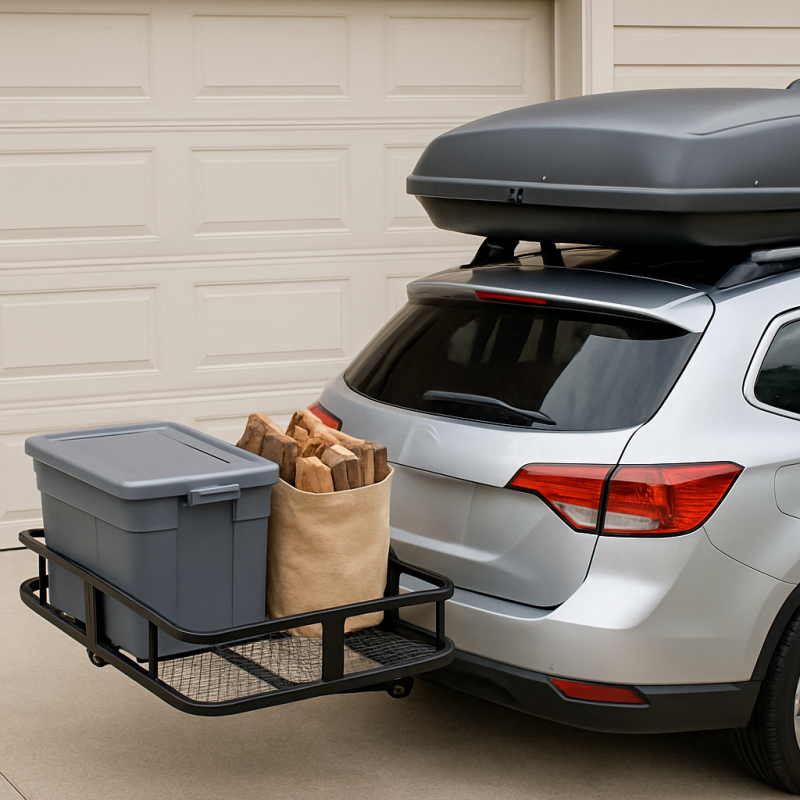
Hitch cargo carriers dominate in raw load capacity, typically handling 400–500 lbs compared to just 110–165 lbs for most rooftop cargo boxes. If you're hauling heavy camping gear, coolers, or toolboxes, a hitch carrier is the only practical option.
| Specification | Hitch Cargo Carrier | Rooftop Cargo Box |
|---|---|---|
| Weight Capacity | 400–500 lbs | 110–165 lbs |
| Platform Size | 49"–60" × 19"–24" | 53"–70" × 27"–34" |
| Storage Volume | Open (unlimited height) | 11–18 cubic ft |
| Oversized Items | Yes (strapped down) | No (must fit inside) |
| Typical Weight | 35–55 lbs (carrier itself) | 35–60 lbs (box itself) |
The numbers tell a clear story. A carrier like the OKLEAD 500 Lbs Heavy Duty Hitch Mount Cargo Carrier gives you a 60" × 24" platform with 500 lbs capacity — enough for multiple coolers, firewood, and camping chairs. Meanwhile, even a large rooftop box typically maxes out around 165 lbs.
- Heavy gear (coolers, generators, toolboxes): Hitch carrier wins — no contest on weight capacity.
- Soft goods (sleeping bags, clothing, sports equipment): Rooftop box works well since these items are light but bulky.
- Oddly shaped items (fishing rods, skis, lumber): Rooftop box handles long, narrow items better with its enclosed length.
Keep in mind that your vehicle's tongue weight rating and roof load rating are the real limits, not just the carrier's specs. Most trucks handle hitch carriers easily. For rooftop loads, check your owner's manual — the dynamic roof load rating is often lower than people expect, typically 100–200 lbs including the rack and box itself.
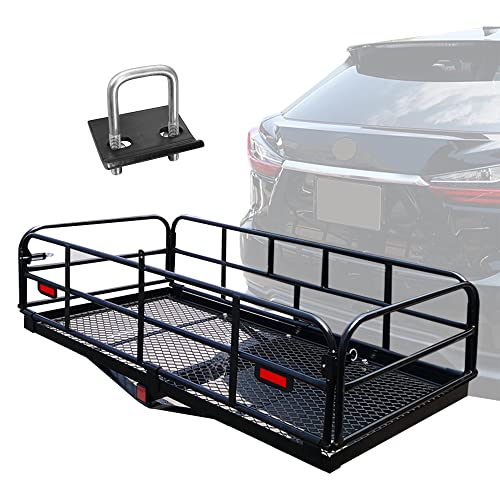
OKLEAD 500 Lbs Heavy Duty Hitch Mount Cargo Carrier
Extra-large 60" × 24" platform with 14.4" high side rails gives you the most usable space among hitch carriers. The folding design stores flat against the hitch when not in use.
Check Price On AmazonIf you click this link and buy, we earn a commission at no additional cost to you.
Which Option Is Easier to Load and Access?
Hitch cargo carriers are significantly easier to load because they sit at bumper height — roughly 18–24 inches off the ground. Rooftop boxes require lifting every item overhead, which is difficult with heavy gear and nearly impossible for shorter individuals without a step stool.
- Hitch carrier loading height: 18–24 inches (waist level or below).
- Rooftop box loading height: 60–80 inches depending on vehicle height. On a full-size truck, you're reaching 7+ feet.
- Mid-trip access: Hitch carriers let you grab gear in seconds. Rooftop boxes may require opening latches from the side and reaching in.
This difference matters most on road trips where you need frequent access. Imagine stopping for lunch and needing the cooler. With a hitch carrier, you walk to the back and grab it. With a rooftop box on a truck, you're climbing up or using the tailgate as a step.
The WEIZE Folding Hitch Mount Cargo Carrier even folds up flat when not in use, staying mounted without blocking your tailgate. Many rooftop boxes are cumbersome to remove and store — most people leave them on all season, which affects fuel economy even when empty.
- Solo loading: Hitch carrier is a one-person job. Rooftop boxes often require two people for heavy items.
- Organizing gear: Rooftop boxes let you pack items neatly inside compartments. Hitch carriers need cargo nets and straps to keep things secure.
- Elderly or mobility-limited users: Hitch carriers are the only realistic option since overhead lifting isn't required.
How Does Each Option Affect Fuel Economy and Driving?
Rooftop cargo boxes create substantial aerodynamic drag that can reduce fuel economy by 10–25% at highway speeds. Hitch cargo carriers sit in the vehicle's slipstream and have minimal impact on MPG, typically 1–5% at most.
| Factor | Hitch Cargo Carrier | Rooftop Cargo Box |
|---|---|---|
| Fuel Economy Impact | 1–5% reduction | 10–25% reduction |
| Highway Wind Noise | None | Moderate to noticeable |
| Center of Gravity | Low (minimal effect) | Raised (affects handling) |
| Clearance Impact | Reduces rear departure angle | Increases overall height |
| Parking Garage Access | Adds 18"–24" to rear length | May exceed height limits |
A study from the U.S. Department of Energy found that rooftop cargo can reduce fuel economy by 2–8% in city driving and 6–17% on the highway, with large boxes at the higher end. Some independent tests show even greater losses at sustained speeds above 65 mph.
- Long highway trips: The fuel cost difference adds up fast. On a 1,000-mile road trip averaging 20 MPG at $3.50/gallon, a 15% MPG loss from a rooftop box costs an extra $26–$30 in fuel.
- Wind noise: Rooftop boxes produce a noticeable hum or whistle at highway speeds that some drivers find distracting.
- Crosswinds: A rooftop box acts as a sail in strong crosswinds, making the vehicle feel less stable, especially on open highways.
Hitch carriers do add length to your vehicle, which affects your rear departure angle — important for off-road driving or steep driveways. They can also obstruct your rear visibility slightly, though most extend below the rear window sightline.
For handling, a loaded rooftop box raises the center of gravity noticeably. On trucks and tall SUVs, this effect is less dramatic than on sedans, but you'll still feel it during sharp turns or emergency maneuvers.
Which Is More Weatherproof and Secure?
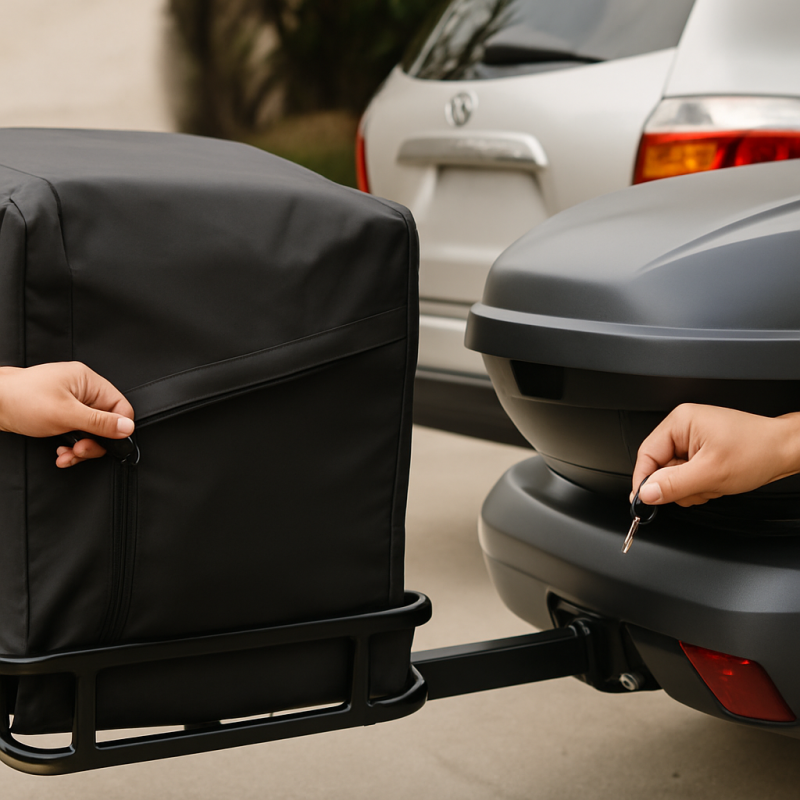
Rooftop cargo boxes are inherently weatherproof and lockable — your gear stays dry and secure inside a sealed hard shell. Hitch cargo carriers are open by default, meaning you need separate covers, bags, and locks to protect your gear from rain and theft.
- Rooftop box weather protection: Fully enclosed with gaskets and seals. Most quality boxes keep gear dry in heavy rain.
- Hitch carrier weather protection: None built-in. Requires a waterproof cargo bag or tarp secured with straps.
- Rooftop box security: Built-in key locks on most models. Deters casual theft — gear isn't visible.
- Hitch carrier security: Everything is visible and accessible. Cable locks help but won't stop a determined thief.
If you frequently park at trailheads, hotel parking lots, or rest stops, a rooftop box gives you peace of mind that a hitch carrier simply can't match. Models like the 70 Inch Rooftop Cargo Box offer dual-side opening with security keys and 165 lbs capacity — a strong option for road trips where you leave gear unattended.
That said, many hitch carrier owners pair their basket with a waterproof cargo bag. The WEIZE 53" × 19" Hitch Mount Cargo Carrier comes bundled with a waterproof bag, net, and straps — solving the weather problem out of the box.
- Camping trips with campsite supervision: Hitch carrier is fine since you're with your gear.
- Multi-day road trips with hotel stops: Rooftop box provides better overnight security.
- Dusty or muddy conditions: Rooftop box keeps contents clean; open carriers expose gear to road spray.
WEIZE 53" × 19" Hitch Mount Cargo Carrier with Accessories
A complete bundle including the carrier basket, waterproof bag, cargo net, straps, and hitch stabilizer. Solves the weather protection problem that open carriers typically have.
Check Price On AmazonIf you click this link and buy, we earn a commission at no additional cost to you.

70 Inch Rooftop Cargo Box (17.7 Cubic Ft)
One of the largest rooftop boxes available at 17.7 cubic feet with 165 lb capacity. Dual-side opening and security keys make it the top choice for family road trips needing maximum enclosed storage.
Check Price On AmazonIf you click this link and buy, we earn a commission at no additional cost to you.

What Are the Installation and Compatibility Requirements?
Hitch cargo carriers require a 2-inch trailer hitch receiver, which most trucks and many SUVs already have. Rooftop cargo boxes require roof crossbars compatible with your vehicle, which may need to be purchased separately if your vehicle doesn't have a factory roof rack.
- Hitch carrier installation: Slides into receiver, secured with a hitch pin. Takes under 5 minutes. No tools required for most models.
- Rooftop box installation: Mounts to crossbars with clamps or U-bolts. Takes 15–30 minutes and usually requires a second person to lift the box onto the roof.
If your truck doesn't have a hitch yet, you'll need to install a trailer hitch first — a one-time job that typically costs $150–$400 for parts and installation. After that, the hitch serves double duty for towing, bike racks, and cargo carriers.
| Requirement | Hitch Cargo Carrier | Rooftop Cargo Box |
|---|---|---|
| Mounting Point | 2" hitch receiver | Roof crossbars |
| Install Time | Under 5 minutes | 15–30 minutes |
| Tools Needed | Hitch pin only | Wrench or included hardware |
| People Needed | 1 person | 1–2 people |
| Removal | Pull pin, slide out | Unclamp, lift off (heavy) |
| Prerequisite Cost | $150–$400 (if no hitch) | $100–$300 (if no crossbars) |
One compatibility note: hitch carriers can block your tailgate from opening fully on some trucks. Folding carriers solve this — they flip up when not loaded so you can access the bed. Also, if you tow a trailer, you can't use a hitch carrier at the same time since they occupy the same receiver.
- Towing compatibility: Hitch carrier and trailer can't be used simultaneously (unless you use a dual-receiver adapter, which reduces capacity).
- Roof rack compatibility: Rooftop boxes work alongside other roof accessories like kayak carriers, but space on the crossbars is limited.
Which Option Gives You Better Value for the Money?
Hitch cargo carriers offer significantly better value, with quality options starting at $80–$150 versus $200–$600 for rooftop cargo boxes. When you factor in the per-pound cost of cargo capacity, hitch carriers deliver roughly 3–5× more value.
| Price Tier | Hitch Cargo Carrier | Rooftop Cargo Box |
|---|---|---|
| Budget ($50–$150) | Steel basket, 500 lb capacity | Soft bags only (not a box) |
| Mid-Range ($150–$300) | Aluminum basket + accessories | Basic hard-shell box, 11–13 cu ft |
| Premium ($300–$600) | Enclosed hitch cargo box | Large box, 15–18 cu ft, dual-opening |
At the budget level, you can get a highly-rated carrier like the MaxxHaul 70107 Hitch Cargo Carrier for around $80–$100. It's steel construction with high side rails and holds 500 lbs. For the same price, you'd be looking at a flimsy rooftop bag — not a hard-shell box.
- Cost per pound of capacity: Hitch carrier = ~$0.20–$0.40 per lb. Rooftop box = ~$2.00–$5.00 per lb.
- Ongoing fuel costs: Rooftop boxes cost an extra $5–$30 per long trip in additional fuel due to drag.
- Accessory costs: Hitch carriers may need a waterproof bag ($30–$50) and cargo net ($15–$25). Rooftop boxes are self-contained.
If you want lightweight aluminum to reduce carrier weight and resist rust, the MaxxHaul 70108 Aluminum Cargo Carrier is a smart mid-range upgrade. It weighs less than steel options while maintaining the same 500 lb capacity.
Don't forget the prerequisite cost: if you need to buy and install a hitch ($150–$400) or crossbars ($100–$300), factor that into your total investment. Most truck owners already have a hitch, giving carriers an inherent cost advantage.
MaxxHaul 70107 Hitch Cargo Carrier
A budget-friendly steel hitch carrier with high side rails and 500 lb capacity. The 53" × 19.5" platform fits most gear, and it's one of the best-selling carriers for good reason.
Check Price On AmazonIf you click this link and buy, we earn a commission at no additional cost to you.

MaxxHaul 70108 Aluminum Cargo Carrier
Lightweight aluminum construction resists rust and weighs less than steel alternatives, while maintaining the same 500 lb load capacity. Ideal for long-term use in wet or coastal climates.
Check Price On AmazonIf you click this link and buy, we earn a commission at no additional cost to you.

Which Should You Choose? Recommendations by Use Case
The best option depends entirely on what you're hauling, how far you're going, and what vehicle you drive. Here are clear recommendations for the most common scenarios — no fence-sitting.
- Camping and outdoor gear (heavy coolers, firewood, chairs): Choose a hitch cargo carrier. You need the 500 lb capacity and waist-level loading. An open carrier with tie-downs handles bulky, heavy camping equipment far better than a rooftop box.
- Family road trips (luggage, soft bags, sports equipment): Choose a rooftop cargo box. Clothes and soft goods are light, and the locked, weatherproof enclosure means you don't worry about rain or theft at rest stops.
- Ski and snowboard trips: Choose a rooftop cargo box. Long, narrow gear fits perfectly, and you keep wet equipment separate from the cabin.
- Tailgating and short-distance hauling: Choose a hitch cargo carrier. Easy loading, low cost, and fuel economy doesn't matter for short drives.
- Budget-conscious buyers: Choose a hitch cargo carrier. You'll get 3–5× more capacity per dollar spent.
For truck owners who already have a hitch receiver, a carrier is the path of least resistance. The ActiveTrail 60" × 20" Hitch Mount Cargo Carrier offers heavy-duty steel construction at 500 lbs capacity — slides in and you're ready to go.
For SUV drivers planning multi-day road trips, a box like the TUFFIOM 13.4 cu.ft. Rooftop Cargo Box with dual-side opening and waterproof construction protects your gear from the elements and keeps it locked.
Still unsure? Ask yourself one question: Is my gear heavy or light? If it's heavy, go hitch carrier. If it's light and needs protection, go rooftop box. That single factor drives the right decision 90% of the time.
TUFFIOM 13.4 cu.ft. Rooftop Cargo Box
A solid mid-range rooftop box with dual-side opening, waterproof construction, and keyed locks. The 13.4 cubic foot capacity handles most family luggage needs without being oversized.
Check Price On AmazonIf you click this link and buy, we earn a commission at no additional cost to you.

Related Articles
- How to Install a Trailer Hitch on Your Truck — Readers without an existing hitch receiver need installation guidance before using a hitch cargo carrier
- Best Trailer Hitches for Trucks — Choosing the right hitch is a prerequisite for hitch-mounted cargo carriers
- Best Truck Bike Racks for Hitch Mount — Hitch receivers serve multiple purposes including bike racks, showing the versatility of having a hitch installed
- Best Truck Kayak Racks and Carriers — Rooftop boxes share crossbar space with kayak carriers, relevant to compatibility discussion
- Best Truck Bed Cargo Nets — Cargo nets help secure items on open hitch carriers, relevant to the accessibility and security discussion
Conclusion
Recommended Products
MaxxHaul 70107 Hitch Cargo Carrier
A budget-friendly steel hitch carrier with high side rails and 500 lb capacity. The 53" × 19.5" platform fits most gear, and it's one of the best-selling carriers for good reason.
Check Price On AmazonIf you click this link and buy, we earn a commission at no additional cost to you.
MaxxHaul 70108 Aluminum Cargo Carrier
Lightweight aluminum construction resists rust and weighs less than steel alternatives, while maintaining the same 500 lb load capacity. Ideal for long-term use in wet or coastal climates.
Check Price On AmazonIf you click this link and buy, we earn a commission at no additional cost to you.
OKLEAD 500 Lbs Heavy Duty Hitch Mount Cargo Carrier
Extra-large 60" × 24" platform with 14.4" high side rails gives you the most usable space among hitch carriers. The folding design stores flat against the hitch when not in use.
Check Price On AmazonIf you click this link and buy, we earn a commission at no additional cost to you.
WEIZE 53" × 19" Hitch Mount Cargo Carrier with Accessories
A complete bundle including the carrier basket, waterproof bag, cargo net, straps, and hitch stabilizer. Solves the weather protection problem that open carriers typically have.
Check Price On AmazonIf you click this link and buy, we earn a commission at no additional cost to you.
70 Inch Rooftop Cargo Box (17.7 Cubic Ft)
One of the largest rooftop boxes available at 17.7 cubic feet with 165 lb capacity. Dual-side opening and security keys make it the top choice for family road trips needing maximum enclosed storage.
Check Price On AmazonIf you click this link and buy, we earn a commission at no additional cost to you.
TUFFIOM 13.4 cu.ft. Rooftop Cargo Box
A solid mid-range rooftop box with dual-side opening, waterproof construction, and keyed locks. The 13.4 cubic foot capacity handles most family luggage needs without being oversized.
Check Price On AmazonIf you click this link and buy, we earn a commission at no additional cost to you.
Frequently Asked Questions
Can I use a hitch cargo carrier and tow a trailer at the same time?
How much does a rooftop cargo box affect gas mileage?
Do hitch cargo carriers damage your car's frame?
Are rooftop cargo boxes waterproof?
Can I put a hitch cargo carrier on an SUV or car?
How do I keep gear dry on an open hitch cargo carrier?
Will a rooftop cargo box fit in my garage?
Which is safer — a hitch cargo carrier or rooftop cargo box?
Affiliate Disclosure: This article contains affiliate links. If you purchase through these links, we may earn a commission at no extra cost to you.