Truck Recovery Basics Every Driver Should Know
Key Takeaways
- Every truck should carry a minimum recovery kit with a tow strap, D-ring shackles, gloves, and a tree saver — total cost under $80.
- Never attach a recovery strap to a truck's bumper, ball hitch, or tie-down hooks — only use frame-mounted recovery points rated for the vehicle's weight.
- Kinetic recovery ropes stretch 20-30% under load and generate momentum, making them safer and more effective than static chains for pulling stuck vehicles.
- A stuck truck's tires should be aired down to 15-20 PSI before attempting recovery — this single step frees vehicles roughly 60% of the time without any external pull.
- Self-recovery with a winch is the safest solo option, but improper winch use causes over 10 reported fatalities per year in North America.
What Is Truck Recovery and Why Should You Care?
Truck recovery is the process of extracting a vehicle that's immobilized — stuck in mud, sand, snow, or a ditch — using specialized gear and techniques. Every truck driver should understand recovery basics because getting stuck isn't a matter of if, it's a matter of when.
- Mud and soft ground: the most common scenario, especially during spring thaw and rainy seasons
- Snow and ice: winter driving puts even 4WD trucks in ditches regularly
- Sand: beach access roads and desert trails trap trucks that don't air down
- Steep grades: failed hill climbs on trails can leave trucks stranded at awkward angles
- Water crossings: misjudging depth or current causes stuck and stalled vehicles
According to the National Safety Council, improper vehicle recovery contributes to thousands of roadside injuries annually. Many of these involve makeshift recovery attempts — using tow chains wrapped around bumpers, attaching straps to ball hitches, or yanking stuck vehicles with no slack management.
The consequences of a failed recovery go beyond inconvenience:
- Vehicle damage: bent frames, torn bumpers, snapped axles, and transmission failure from improper pulling
- Personal injury: broken straps and flying shackles can be lethal — a 3/4-inch shackle under load carries the energy of a bullet
- Expensive tow bills: a professional off-road recovery service runs $500-$2,000+ depending on location and difficulty
- Stranding: a botched self-recovery can make the situation worse, turning a 20-minute fix into an overnight ordeal
Learning proper recovery techniques costs nothing and takes an afternoon. The gear investment is minimal — under $150 for a solid basic kit. There's no good reason to drive unprepared.
What Recovery Gear Should Every Truck Carry?
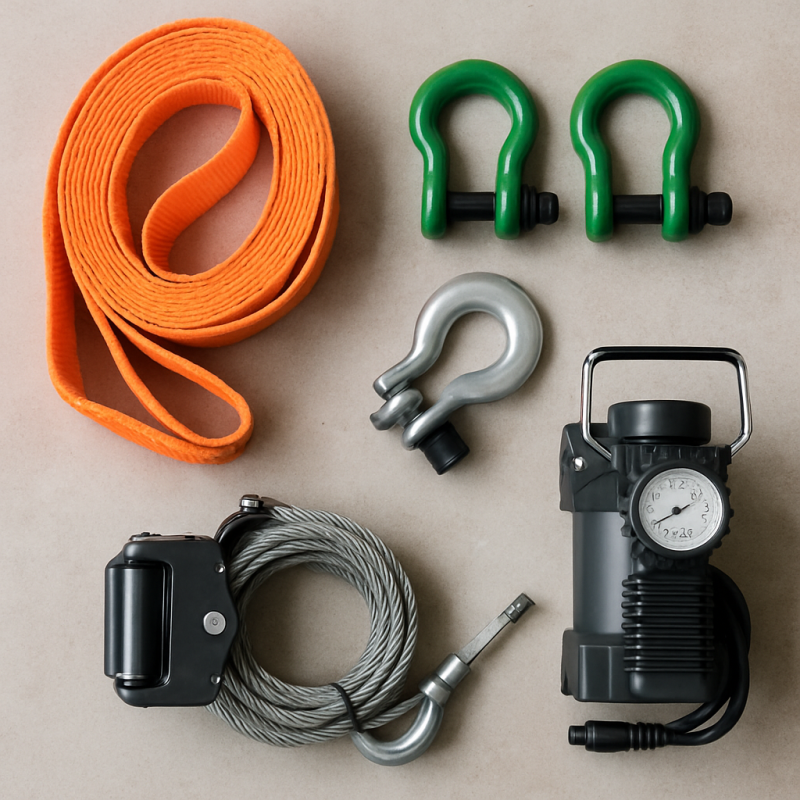
At minimum, every truck should carry five core recovery items that fit in a small duffel bag behind the rear seat or in the bed. These basics handle 80% of stuck situations without needing a winch or professional help.
- Recovery tow strap (20-30 ft, 20,000+ lb rating): the primary extraction tool — always choose a strap rated at 2-3x your vehicle's gross weight
- D-ring shackles (pair, 3/4-inch): connect the strap to recovery points — never substitute with hardware store carabiners or hooks
- Tree saver strap (8-10 ft): wraps around a tree or anchor without damaging bark, distributes load evenly
- Leather gloves: protect hands from frayed straps, hot metal, and mud
- Tire deflator or gauge: airing down is the single most effective self-recovery technique
For drivers who venture off-road regularly, an expanded kit adds significant capability:
- Kinetic recovery rope: stretches under load to build momentum — far superior to static straps for deep mud
- Hi-Lift or farm jack: lifts the vehicle to place traction aids under tires
- Traction boards (MaxTrax or similar): provide a solid surface for tires to grip
- Folding shovel: for digging out packed mud, snow, or sand around tires
- Snatch block/pulley: doubles a winch's pulling capacity and changes pull direction
Quality matters with recovery gear. A purpose-built recovery kit from a reputable brand uses reinforced stitching, forged shackles, and properly rated materials. Cheap straps from discount bins have failed catastrophically under load. Look for minimum breaking strength (MBS) ratings — your strap should be rated for at least 2x your vehicle's GVWR.
Store all recovery gear in a dedicated bag, not loose in the bed. Wet, dirty straps degrade faster, and scattered gear wastes critical time when you're stuck.
How Do You Safely Recover a Stuck Truck with a Tow Strap?
A tow strap recovery requires two vehicles — one stuck and one pulling — and follows a specific sequence to prevent damage and injury. Rushing this process or skipping steps is how straps break and people get hurt.
Step-by-step strap recovery process:
- Assess the situation: determine what's holding the truck — mud suction, high-centered frame, buried tires, or a combination
- Position the recovery vehicle: park on solid ground, directly in line with the stuck truck's direction of travel — never pull at sharp angles
- Locate factory recovery points: check both vehicles for frame-mounted tow hooks or recovery loops — consult the owner's manual if unsure
- Attach the strap: connect D-ring shackles to both vehicles' recovery points, then clip the strap to the shackles — finger-tighten the shackle pin, then back off 1/4 turn
- Lay a dampener: drape a heavy blanket, jacket, or commercial strap dampener over the strap's midpoint — this absorbs energy if the strap breaks
- Clear all bystanders: everyone must stand at least 1.5x the strap length away, perpendicular to the pull — never behind or in front of either vehicle
- Communicate signals: agree on hand signals or use radios — the stuck driver controls the operation and signals when to pull
- Take up slack slowly: the recovery vehicle drives forward gently until the strap is taut — no jerking
- Apply steady, progressive power: the recovery vehicle accelerates smoothly while the stuck truck drives forward simultaneously
Critical safety rules during strap recovery:
- Never attach to a ball hitch: the ball can shear off and become a deadly projectile
- Never use a tow chain for pulling: chains don't stretch, creating dangerous shock loads
- Never wrap a strap around an axle: this damages brake lines and CV joints
- Both drivers stay in their vehicles: with seatbelts on during the pull
If the first pull doesn't work, stop and reassess. Dig out more mud, air down further, or try a different angle. Repeated hard pulls on a deeply stuck truck usually just dig it in worse.
When Should You Use a Winch Instead of a Tow Strap?
A winch is the better choice when you're stuck alone with no second vehicle, when the terrain prevents another truck from getting close, or when the extraction requires slow, controlled pulling over obstacles. A tow strap works best for quick pulls on relatively flat ground with a nearby recovery vehicle.
| Factor | Tow Strap | Winch |
|---|---|---|
| Requires second vehicle | Yes | No — self-recovery capable |
| Cost | $30-$80 | $300-$1,500+ installed |
| Best terrain | Flat mud, snow, sand | Steep grades, rocks, deep mud |
| Speed of recovery | Fast — minutes | Slower — 10-30 minutes setup |
| Control | Less precise | Highly controlled, inch-by-inch |
| Risk level | Moderate (strap failure) | Higher (cable snap, mechanical failure) |
| Weight | 2-5 lbs | 60-90 lbs mounted |
Winching requires solid anchor points — large trees, boulders, or buried anchors. The Tread Magazine winching guide recommends using trees with a minimum 8-inch trunk diameter and always protecting the bark with a tree saver strap.
If you already have a winch mounted, understanding proper winch recovery techniques is essential before you ever need to use it. Key winch safety rules include:
- Always use gloves: wire rope develops burrs that slice skin instantly
- Never step over a loaded cable: a snapped cable sweeps at shin height with lethal force
- Use a snatch block to double pulling power and reduce cable stress
- Keep at least 5 wraps of cable on the drum at all times — fewer wraps reduce holding power dramatically
- Drape a dampener over the cable just as you would with a recovery strap
For most truck owners who stick to highways, gravel roads, and occasional mild trails, a quality recovery strap kit is sufficient. Invest in a winch only if you regularly drive remote trails where no second vehicle may be available for hours.
What Are the Most Common Recovery Mistakes?
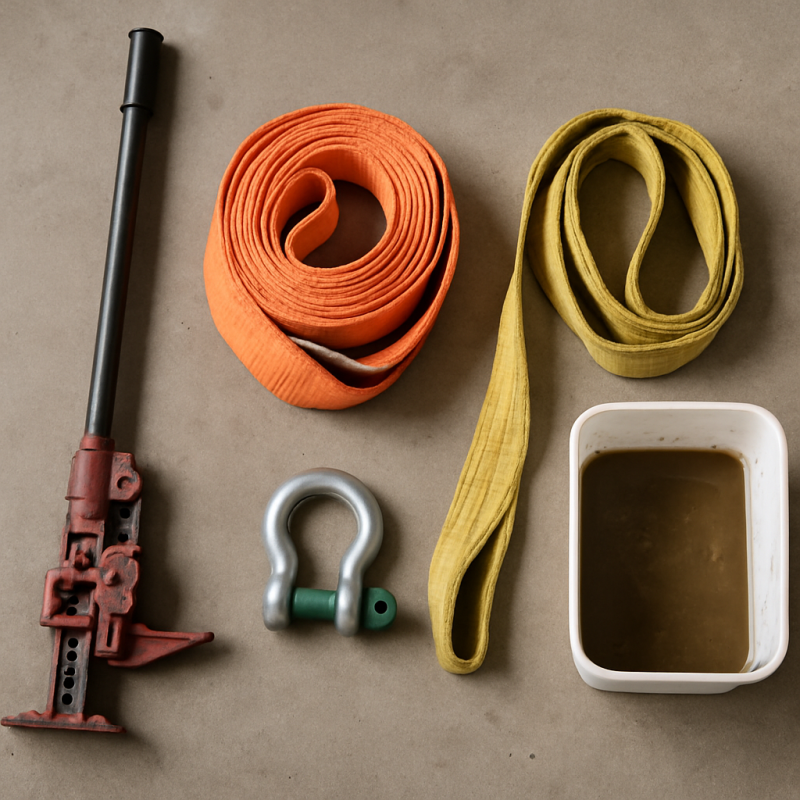
The most dangerous recovery mistake is attaching a strap or chain to a point not rated for recovery loads — ball hitches, bumpers, and tie-down hooks. This single error causes the majority of recovery-related injuries and deaths each year.
Equipment mistakes:
- Using a tow chain instead of a recovery strap: chains transmit full shock load instantly with no give — they break attachment points, bend frames, and snap violently when they fail
- Wrong strap rating: using a 5,000 lb strap on a 6,500 lb truck is a recipe for failure — always rate at 2-3x vehicle weight
- Old or damaged gear: UV-degraded nylon straps lose up to 50% of their rated strength — inspect straps before every use and replace any with fraying, cuts, or stiffness
- No dampener on the line: an undampened strap or cable that breaks turns shackles into projectiles
Technique mistakes:
- Jerking or snatching too aggressively: momentum is good, but violent jerks multiply force beyond equipment ratings
- Pulling at sharp angles: side-loading recovery points can bend or tear them from the frame
- Spinning tires excessively: this digs the truck deeper and overheats the drivetrain — if tires spin for more than 5 seconds, stop and reassess
- Not airing down first: most drivers skip this step entirely — reducing tire pressure to 15-20 PSI increases the contact patch by 30-40%, often providing enough traction to self-extract
- Ignoring bystander positioning: spectators naturally stand behind the recovery vehicle — the exact worst place to be if gear fails
The UK Forestry Commission documented that 73% of off-road recovery incidents involved at least one of these basic errors. Take the extra two minutes to do it right — there are no shortcuts worth the risk.
How Do You Self-Recover Without a Second Vehicle?
Self-recovery starts with the lowest-effort techniques first — airing down tires, clearing debris, and rocking the vehicle. Only escalate to winching or jacking when simpler methods fail. Most stuck situations don't require another truck or heavy equipment.
The self-recovery sequence (in order of escalation):
- Stop digging: the moment your tires spin without movement, stop. Every second of spinning digs you deeper and heats your drivetrain
- Air down tires to 15-20 PSI: this is the most underrated recovery technique — the wider contact patch floats the truck over soft surfaces
- Clear around the tires: use a shovel or even your hands to remove mud, snow, or sand packed against the sidewalls and ahead of the tires
- Try gentle rocking: shift between drive and reverse with minimal throttle — let the transmission do the work, not wheel speed
- Use traction aids: place floor mats, traction boards, branches, or even gravel under the drive wheels
- Use a jack to lift and pack: jack up the stuck wheel and fill the void underneath with rocks, branches, or traction boards
- Winch out: if equipped, use your winch anchored to a solid tree or a ground anchor
A few items already in your truck can serve as emergency traction aids when you don't have dedicated recovery gear:
- Rubber floor mats: surprisingly effective on ice and packed snow
- Cat litter: absorbs moisture and provides grip on ice
- Cardboard: a flattened box under a tire provides enough grip for a gentle extraction
- Your truck's carpet: a last resort, but it works
If you camp or travel in remote areas, pairing recovery gear with a reliable portable power station ensures you can keep phones charged and run a tire inflator to re-air your tires after extraction. Getting unstuck is only half the job — you need to get back to highway pressures before driving home.
How Do You Choose the Right Recovery Points on Your Truck?
Factory recovery points are the only attachment locations rated for full-vehicle extraction loads. These are bolted or welded directly to the frame and designed to handle forces equal to or greater than the truck's gross vehicle weight. Everything else — bumpers, hitch balls, tie-downs — will fail under recovery loads.
Where to find your truck's recovery points:
- Front: most trucks have two tow hooks bolted to the front frame horns, visible below the bumper — common on F-150, Silverado, Ram, Tundra, and Tacoma
- Rear: factory rear recovery points are less common — many trucks rely on the hitch receiver (the square tube, NOT the ball) with a properly rated D-ring receiver insert
- Frame: some trucks have additional frame-mounted loops underneath — check your owner's manual for locations and ratings
What NOT to use as a recovery point:
- Ball hitch mount: the ball can shear clean off — a 2-inch ball weighs about 2 lbs and becomes a lethal projectile at strap-snap speeds
- Aftermarket bumpers without recovery tabs: decorative bumpers bolt to the frame with hardware not rated for lateral recovery loads
- Bed tie-down hooks: rated for 200-500 lbs of cargo securement — not 10,000+ lbs of recovery force
- Tow bar loops: some are cosmetic and not structurally reinforced
If your truck lacks adequate recovery points, aftermarket recovery shackle mounts bolt directly to the frame and are rated for recovery loads. Brands like Factor 55 make receiver-mounted and frame-mounted options that meet or exceed OEM ratings.
A quality hitch receiver rated for your truck's weight class can serve as a rear recovery point when paired with a D-ring hitch insert — just ensure the insert is rated for recovery, not just towing.
Before any recovery attempt, physically inspect the recovery point. Look for rust, cracks, loose bolts, or bending. A compromised recovery point is worse than no recovery point — it gives false confidence.
When Should You Call a Professional Recovery Service?
Call a professional when the vehicle is at risk of rolling, when water is rising, when the terrain prevents safe self-recovery, or when you've attempted extraction twice without progress. There's no shame in calling for help — it's cheaper than a destroyed truck or a hospital visit.
Situations that require professional recovery:
- Vehicle on a steep slope at risk of rollover: any angle greater than 30 degrees requires specialized rigging
- Submerged or partially submerged vehicle: water-logged trucks need careful extraction to avoid hydrolocking the engine
- High-centered on rocks or stumps: the vehicle's weight is resting on the frame, not the wheels — this requires lifting equipment
- Broken axle, driveshaft, or steering: a disabled drivetrain means the vehicle can't assist in its own recovery
- No safe anchor points available: open fields, sandy flats, and desert terrain often lack trees or rocks for winch anchoring
- Night recovery without proper lighting: poor visibility multiplies every risk factor
What to expect from professional recovery costs:
| Scenario | Typical Cost |
|---|---|
| Road ditch extraction | $150-$350 |
| Mild off-road (within 1 mile) | $300-$600 |
| Remote trail recovery | $500-$1,500 |
| Vehicle rollover/flip | $1,000-$3,000+ |
| Water/swamp extraction | $800-$2,500 |
Before heading into remote areas, save the number of a local off-road recovery service — standard tow companies often won't go off-pavement. Many off-road clubs also maintain volunteer recovery networks that respond for free or for the cost of fuel.
Your insurance may cover recovery costs under roadside assistance or comprehensive coverage. Check your policy before you need it — some policies exclude off-road recovery, while others cover it fully. Adding roadside assistance to most truck insurance policies costs $10-$20 per year.
The bottom line: if you've tried airing down, digging out, and one careful strap pull without success, the situation is beyond basic recovery. Call for help before you make it worse.
Related Articles
- Best Tow Straps and Recovery Kits for Trucks — Directly relevant review of recovery straps and kits discussed throughout this article
- How to Use a Truck Winch for Recovery — Step-by-step winch guide referenced in the winch vs strap section
- Best Portable Power Stations for Truck Camping — Referenced for keeping devices charged and running tire inflators during remote recovery
- Best Trailer Hitches for Trucks — Referenced as a rear recovery point option when paired with a D-ring insert
Conclusion
Frequently Asked Questions
Can I use a tow chain to pull a stuck truck?
What PSI should I air my tires down to when stuck?
Is it safe to attach a recovery strap to my trailer hitch ball?
What's the difference between a tow strap and a kinetic recovery rope?
How much does professional off-road recovery cost?
Do I need a winch on my truck for recovery?
What size recovery strap do I need for my truck?
Can I recover a stuck truck by myself without any gear?
Affiliate Disclosure: This article contains affiliate links. If you purchase through these links, we may earn a commission at no extra cost to you.