Portable Power Station vs Generator for Camping
Choosing between a portable power station and a gas generator for camping comes down to how you camp, what you need to power, and how long you'll be off-grid. Both options have evolved dramatically in recent years — lithium battery stations have gotten more powerful and affordable, while inverter generators have become quieter and more fuel-efficient. But they serve fundamentally different use cases.
This comparison breaks down the real-world differences across noise, cost, runtime, portability, and environmental impact. By the end, you'll know exactly which option fits your camping style — whether you're truck camping for a weekend or running a base camp for a week.
Key Takeaways
- Portable power stations run silently and produce zero emissions, making them ideal for tent camping and national park campgrounds with noise restrictions.
- Gas generators deliver significantly more sustained wattage per dollar, making them the better choice for powering high-draw appliances like portable AC units or electric heaters.
- LiFePO4 battery stations last 3,000+ charge cycles (roughly 8-10 years of regular use), while gas generators require ongoing fuel costs and annual maintenance.
- For weekend truck camping trips powering phones, lights, and a mini fridge, a 300-1000Wh portable power station covers most campers' needs without the hassle of fuel.
- Gas generators remain unbeatable for extended off-grid stays where solar recharging isn't reliable and you need continuous power beyond 1-2 days.
What's the Core Difference Between Power Stations and Generators?
A portable power station is a rechargeable lithium battery with built-in inverter and outlets — think of it as a giant, sophisticated power bank. A gas generator burns fuel to produce electricity on demand with no storage limit beyond your fuel supply.
This fundamental difference drives every other comparison point. One stores energy, the other creates it. Here's how they break down at a glance:
| Feature | Portable Power Station | Gas Generator |
|---|---|---|
| Power Source | Rechargeable lithium battery (LiFePO4 or Li-ion) | Gasoline, propane, or dual fuel |
| Noise Level | 0-30 dB (virtually silent) | 48-75 dB (conversation to vacuum level) |
| Emissions | Zero — safe for indoor/tent-adjacent use | Carbon monoxide — outdoor use only |
| Runtime | Fixed by battery capacity (Wh) | Unlimited with fuel resupply |
| Typical Wattage | 200W-3,000W | 1,000W-6,800W+ |
| Weight Range | 3-45 lbs | 35-120+ lbs |
| Maintenance | None — charge and store | Oil changes, spark plugs, fuel stabilizer |
| Recharging | Wall outlet, solar panels, car charger | Add gasoline |
For most casual campers running phones, LED lights, a CPAP machine, and maybe a mini cooler, a power station handles the job without the noise, fumes, or maintenance headaches. But if you need to run a space heater, air conditioner, or power tools at a remote worksite, a generator's sustained output is hard to beat.
How Do They Compare on Noise and Campground Rules?
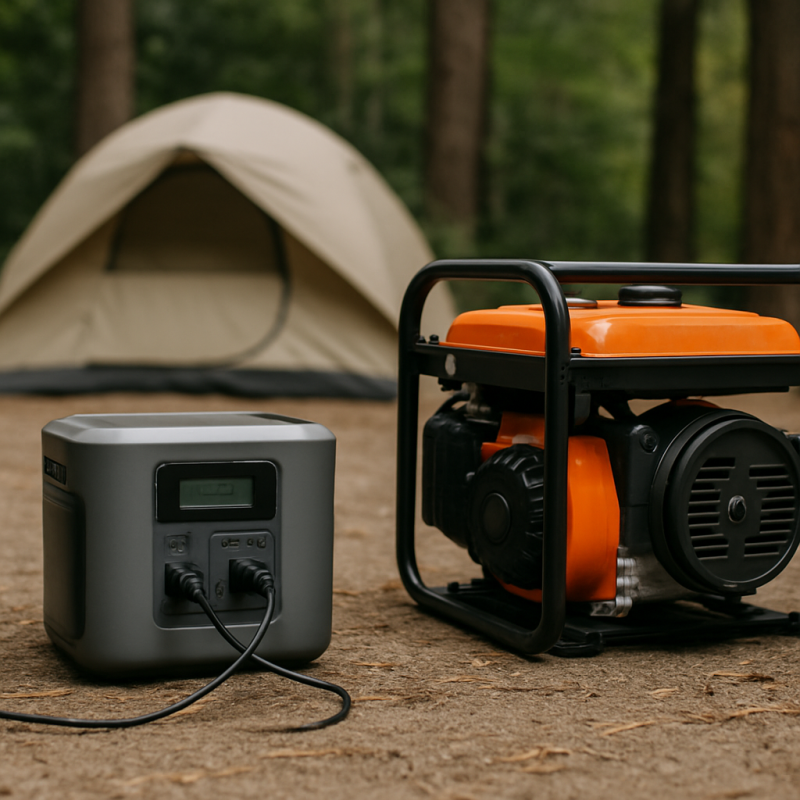
Portable power stations are virtually silent, operating at 0-30 dB — quieter than a whisper. Gas generators range from 48 dB (quality inverter models) to 75+ dB (conventional open-frame units), which can disturb neighbors and wildlife. This single factor often decides the choice for campground campers.
- National parks and state campgrounds: Many enforce strict quiet hours (typically 10 PM to 6 AM) and some ban generators entirely. Power stations face zero restrictions.
- BLM land and dispersed camping: No noise rules, but running a generator in pristine wilderness feels wrong to many campers — and your neighbors at popular spots may feel the same.
- RV parks: Most allow generators during daytime hours but have specific dB limits. Inverter generators like the Champion 4000-Watt Inverter Generator with quiet technology stay within most park limits at 50-58 dB.
The National Park Service has increasingly prioritized natural soundscapes, and many parks now explicitly restrict or prohibit generator use. If you camp primarily in established campgrounds, a power station eliminates rule-checking entirely.
There's also the carbon monoxide safety factor. The Consumer Product Safety Commission reports that portable generators cause an average of 70+ CO-related deaths annually. You must run generators outdoors, at least 20 feet from tents and sleeping areas, with exhaust pointing away. Power stations produce zero emissions and can safely run inside your tent or truck cab.
Which Option Gives You More Runtime and Power?
Gas generators win on sustained, high-wattage runtime — as long as you have fuel, they keep producing power. Portable power stations are limited by their battery capacity, measured in watt-hours (Wh). However, for typical camping loads, even a mid-range power station lasts longer than most people expect.
Here's a real-world runtime comparison for common camping devices:
| Device | Wattage | 300Wh Power Station | 1,000Wh Power Station | 2,500W Gas Generator (1 gal) |
|---|---|---|---|---|
| Phone charging (x2) | 20W | ~12 hours | ~40 hours | 5+ hours (full tank) |
| LED camp lights | 10W | ~24 hours | ~80 hours | 5+ hours |
| CPAP machine | 30-60W | 4-8 hours | 14-28 hours | 5+ hours |
| Mini fridge/cooler | 45-60W | 4-5 hours | 14-18 hours | 5+ hours |
| Electric blanket | 100-200W | 1.5-2.5 hours | 4-8 hours | 5+ hours |
| Portable AC unit | 800-1,500W | Not feasible | 40-75 min | 2-4 hours |
For a typical weekend truck camping trip where you're charging devices and running a few small appliances, a 1,000Wh power station like the Jackery Explorer 1000 v2 handles the full weekend comfortably. Add a 100W solar panel and you can extend that indefinitely in sunny conditions.
But if you're running a portable air conditioner, space heater, or multiple high-draw appliances simultaneously, a generator's continuous output — 2,500W to 6,800W+ — is simply in a different league.
Jackery Explorer 1000 v2 Portable Power Station
With 1,070Wh LiFePO4 battery and 1,500W output, this is the sweet spot for truck campers who need reliable weekend power without the bulk and noise of a generator.
Check Price On AmazonIf you click this link and buy, we earn a commission at no additional cost to you.

What Does Each Option Really Cost Over Time?
Portable power stations have a higher upfront cost but near-zero ongoing expenses. Gas generators cost less initially but accumulate fuel and maintenance costs that add up quickly over years of camping.
- Entry-level power station (200-300Wh): $80-$300 upfront, no ongoing costs. Units like the MARBERO 88Wh Portable Power Station start under $100 for basic charging needs.
- Mid-range power station (500-1,000Wh): $300-$800 upfront. The sweet spot for most campers.
- Premium power station (1,000-2,000Wh): $700-$1,500+. Models like the EF ECOFLOW DELTA 2 with 1,024Wh LiFePO4 battery offer serious capacity.
- Inverter generator (2,000-4,000W): $300-$1,000 upfront, plus $3-$8 per camping trip in fuel, $30-$60/year in maintenance.
Over a 5-year period with 20 camping trips per year, here's the total cost comparison:
| Cost Factor | 1,000Wh Power Station | 2,500W Inverter Generator |
|---|---|---|
| Purchase Price | $500-$800 | $400-$700 |
| Fuel (5 years) | $0 | $500-$800 |
| Maintenance | $0 | $150-$300 |
| Solar Panel (optional) | $100-$250 | N/A |
| Total 5-Year Cost | $600-$1,050 | $1,050-$1,800 |
LiFePO4 power stations last 3,000+ charge cycles, meaning 8-10 years of regular use before significant capacity degradation. Older Li-ion models manage 500-800 cycles. Either way, the long-term economics increasingly favor battery power for moderate camping loads.
MARBERO 88Wh Portable Power Station
Ultra-compact and budget-friendly option for campers who only need to charge phones, cameras, and small LED lights. Perfect as a minimalist backup power source.
Check Price On AmazonIf you click this link and buy, we earn a commission at no additional cost to you.

How Portable and Convenient Are They for Truck Camping?
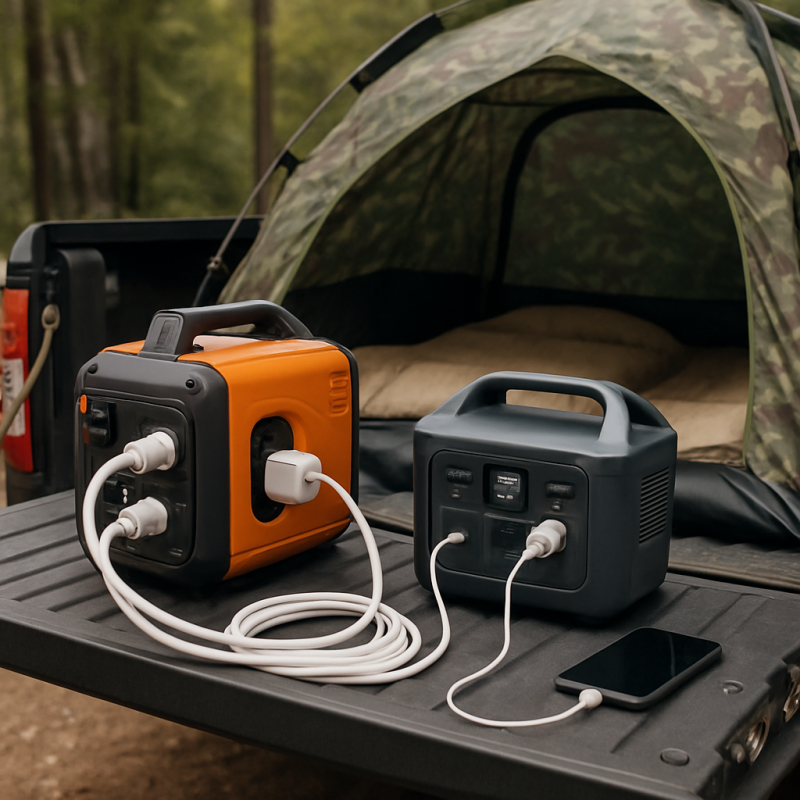
For truck campers, portability and storage footprint matter as much as raw power. A compact power station tucks behind your seat or slides into your camp kitchen setup, while even a small generator takes up significant bed space and requires careful fuel storage.
- Weight: A 300Wh power station weighs 7-8 lbs. A 1,000Wh unit runs 25-30 lbs. A 2,500W inverter generator weighs 45-55 lbs, plus 6+ lbs per gallon of fuel.
- Size: Power stations are roughly toaster to microwave-sized. Generators need 2-3x the footprint plus clearance for ventilation.
- Fuel logistics: No gas cans to transport, no ethanol degradation worries, no fuel stabilizer needed for seasonal storage with power stations.
- Setup time: Power stations are plug-and-play. Generators need pull-starting, warm-up time, and proper outdoor positioning.
If you've already optimized your truck bed for camping — with a camp kitchen setup and essential tool sets — a power station integrates far more seamlessly than a generator. You can keep it inside your sleeping area, charge devices silently overnight, and run your cooking gear without hauling a heavy machine out of the bed.
Generators also demand proper storage practices. Between trips, you should drain or stabilize fuel, run the carburetor dry, and store in a ventilated area. Power stations? Charge to 50-80%, store anywhere, and they're ready when you are — even months later.
The convenience gap narrows for RV camping where a dedicated generator compartment exists and fuel management is part of the routine. But for pickup truck camping, the grab-and-go simplicity of a power station is a major advantage.
EF ECOFLOW DELTA 2 Portable Power Station
1,024Wh LiFePO4 battery with 1,800W AC output handles demanding loads that would normally require a generator. Expandable capacity for extended trips.
Check Price On AmazonIf you click this link and buy, we earn a commission at no additional cost to you.

Can Solar Panels Replace a Generator Entirely?
Solar recharging is the game-changer that tips many campers toward portable power stations. Pair a 100-200W folding solar panel with a 1,000Wh station, and you can camp indefinitely in sunny conditions — no fuel runs, no noise, no emissions.
- 100W panel: Replenishes roughly 300-400Wh per day in full sun (5-6 peak hours). Enough to sustain phone charging, lights, and light appliance use.
- 200W panel: Replenishes 600-800Wh per day. Keeps a 1,000Wh station topped off for moderate loads including a mini fridge.
- Cloudy conditions: Expect 30-50% of rated output. Overcast days in forested campgrounds may drop to 20%. Solar alone isn't reliable in all environments.
Some units like the 300W Portable Solar Generator kit bundle a power station with a foldable 60W panel for a complete off-grid setup right out of the box.
However, solar has real limitations for camping:
- Shade and tree cover: Forest campsites drastically reduce solar input.
- Season and latitude: Winter camping in northern states yields fewer peak sun hours.
- Panel positioning: You need to adjust angle throughout the day for optimal charging.
- High-draw appliances: Solar can't keep up with continuous loads over 200-300W in real-world conditions.
The U.S. Department of Energy notes that average peak sun hours vary from 3.5 hours in the Pacific Northwest to 6+ hours in the Southwest. Plan your solar setup based on where you actually camp, not best-case scenarios.
For truck campers who stick to open terrain in the western states, solar plus a quality power station can truly replace a generator. For Pacific Northwest forest camping or winter trips, carry a generator as backup — or a much larger battery bank.
Anker SOLIX C1000 Gen 2 Portable Power Station
2,000W output with 49-minute full charge makes this ideal for campers who want power station convenience with near-generator wattage. LiFePO4 battery lasts 3,000+ cycles.
Check Price On AmazonIf you click this link and buy, we earn a commission at no additional cost to you.

What Should You Choose Based on Your Camping Style?
The right choice depends entirely on how you camp, what you power, and how long you stay. There's no universal winner — but there is a clear best option for each camping scenario.
Choose a portable power station if you:
- Camp 1-3 nights at a time in campgrounds or dispersed sites
- Power phones, cameras, LED lights, a CPAP, or a mini cooler
- Value silence, zero fumes, and minimal setup
- Camp in national parks or regulated campgrounds
- Want a maintenance-free, grab-and-go solution
- Can supplement with solar panels for longer trips
Choose a gas generator if you:
- Need to run high-wattage appliances (AC units, power tools, electric heaters)
- Camp for 5+ days in areas without reliable sun for solar recharging
- Power an RV with full appliance loads
- Need continuous output over 1,500W for extended periods
- Already have a fuel management routine for your truck or RV
Consider both if you:
- Take both weekend trips and extended off-grid excursions
- Want a silent option for nighttime and a high-output option for daytime
- Run a truck camper that occasionally needs AC or heating
For most truck camping setups, a mid-range portable power station (500-1,000Wh) paired with a 100W solar panel handles 90% of camping scenarios. The Anker SOLIX C1000 Gen 2 with its 1,024Wh LiFePO4 battery and 2,000W output represents the sweet spot — enough power for most needs without generator-level complexity.
If you need generator-level power for occasional big trips, the PowerSmart 2500W Inverter Generator offers a quiet, affordable option that doesn't break the bank as a secondary power source.
Champion 4000-Watt Inverter Generator
When you truly need generator-level power — AC units, heaters, or power tools — this quiet-technology inverter model delivers 4,000W with RV-ready outlets and CO Shield safety.
Check Price On AmazonIf you click this link and buy, we earn a commission at no additional cost to you.

How Do You Safely Use Each Option at the Campsite?
Safety requirements are drastically different between the two options. Power stations require almost no safety precautions, while generators demand strict protocols to prevent carbon monoxide poisoning, fire hazards, and fuel spills.
Portable power station safety:
- Temperature range: Most operate safely between 32°F and 113°F. Extreme cold reduces battery capacity by 10-20%.
- Water protection: Keep dry — most are NOT waterproof. Store inside your vehicle or under shelter during rain.
- Storage: Maintain 50-80% charge for long-term storage. Avoid leaving fully depleted for months.
- Charging: Use manufacturer-approved chargers and solar panels. Don't exceed rated input wattage.
Gas generator safety (critical):
- Carbon monoxide: NEVER run inside a tent, truck cab, camper shell, or any enclosed/semi-enclosed space. Position at least 20 feet from sleeping areas with exhaust directed away.
- Fuel storage: Use approved containers, store away from heat sources and the generator while running. Carry only what you need.
- Refueling: ALWAYS shut down and let the generator cool before adding fuel. Hot engine components can ignite gasoline vapors.
- Grounding: On dry ground, most portable camping generators don't require a ground rod. On wet ground, follow manufacturer instructions.
- CO detectors: Modern generators like the WEN 6800W Dual Fuel include CO Watchdog auto-shutoff features, but you should still carry a battery-powered CO detector in your sleeping area.
The American Red Cross recommends treating every generator like a potential CO source and following strict ventilation protocols. For many camping families, the safety simplicity of a power station is reason enough to choose it over a generator.
Related Articles
- How to Charge Devices While Truck Camping — Directly relevant guide for campers figuring out how to keep electronics charged off-grid
- How to Set Up a Camp Kitchen From Your Truck — Related to optimizing truck bed space and integrating power solutions with camp kitchen gear
- Best Truck Camping Stoves and Cooking Gear — Relevant when discussing power needs for cooking appliances and camp kitchen setups
- Best Portable Power Stations for Truck Camping — Primary product review article for readers ready to buy a portable power station
- Best Truck Bed Tents for Camping — The safety warning about keeping generators 20 feet from tents is directly relevant to truck bed tent campers who need to know safe generator placement relative to their sleeping setup.
- Best Truck Tool Sets for Roadside Repairs — The paragraph discusses optimizing your truck bed with organized gear for camping — tool sets are a natural part of a well-equipped truck camping setup.
Conclusion
Recommended Products
Jackery Explorer 1000 v2 Portable Power Station
With 1,070Wh LiFePO4 battery and 1,500W output, this is the sweet spot for truck campers who need reliable weekend power without the bulk and noise of a generator.
Check Price On AmazonIf you click this link and buy, we earn a commission at no additional cost to you.
MARBERO 88Wh Portable Power Station
Ultra-compact and budget-friendly option for campers who only need to charge phones, cameras, and small LED lights. Perfect as a minimalist backup power source.
Check Price On AmazonIf you click this link and buy, we earn a commission at no additional cost to you.
EF ECOFLOW DELTA 2 Portable Power Station
1,024Wh LiFePO4 battery with 1,800W AC output handles demanding loads that would normally require a generator. Expandable capacity for extended trips.
Check Price On AmazonIf you click this link and buy, we earn a commission at no additional cost to you.
Champion 4000-Watt Inverter Generator
When you truly need generator-level power — AC units, heaters, or power tools — this quiet-technology inverter model delivers 4,000W with RV-ready outlets and CO Shield safety.
Check Price On AmazonIf you click this link and buy, we earn a commission at no additional cost to you.
Anker SOLIX C1000 Gen 2 Portable Power Station
2,000W output with 49-minute full charge makes this ideal for campers who want power station convenience with near-generator wattage. LiFePO4 battery lasts 3,000+ cycles.
Check Price On AmazonIf you click this link and buy, we earn a commission at no additional cost to you.
Frequently Asked Questions
Can a portable power station run an air conditioner while camping?
How long does a portable power station last on a camping trip?
Are portable power stations worth it over generators?
Can you charge a portable power station while driving your truck?
Is it safe to use a generator in a truck camper shell?
What size portable power station do I need for camping?
Do portable power stations work in cold weather?
Can I use a portable power station and generator together?
Affiliate Disclosure: This article contains affiliate links. If you purchase through these links, we may earn a commission at no extra cost to you.