Running Boards vs Nerf Bars: Which Is Right for Your Truck?
Key Takeaways
- Running boards offer a wider, flat stepping surface that's easier for kids, elderly passengers, and anyone loading heavy cargo into the cab.
- Nerf bars are round or oval tubes that prioritize a rugged, sporty look and provide moderate side protection but a smaller stepping area.
- Running boards typically cost $150–$400 while nerf bars range from $100–$350, making nerf bars slightly more budget-friendly on average.
- Choose running boards if daily passenger comfort matters most; choose nerf bars if you want a streamlined off-road aesthetic.
- Both options bolt onto existing factory mounting points on most trucks, requiring no drilling and about 30–60 minutes to install.
What Are Running Boards and Nerf Bars?
Before comparing them side by side, it helps to understand what each product actually is and how they evolved into the two most popular side-step options for trucks and SUVs.
Running boards are flat, wide platforms that mount along the rocker panel beneath your cab doors. They typically measure 5–7 inches wide and run the full length of the cab. The stepping surface is textured or ribbed for grip, and the entire board sits relatively close to the ground.
- Origin: Running boards date back to the earliest automobiles when vehicle frames sat high off the ground and passengers needed a literal stepping platform.
- Modern design: Today's running boards use aluminum, stainless steel, or ABS plastic with anti-slip coatings.
- Mounting: They bolt to factory rocker-panel mounting points using vehicle-specific brackets.
Nerf bars are round or oval steel tubes — usually 3–4 inches in diameter — that run along the same rocker panel area. They include small step pads welded or bolted onto the tube at each door entry point.
- Origin: The term "nerf bar" comes from motorsports, where tubular bars prevented side-to-side contact damage during racing.
- Modern design: Truck nerf bars use mild steel or stainless steel tubing with a polished, powder-coated, or textured black finish.
- Mounting: Same factory mounting points as running boards — installation is straightforward on most popular truck models.
Both products serve the same core purpose — making it easier to step into a lifted or stock-height truck — but they take fundamentally different approaches to the problem.
Design and Stepping Surface Compared
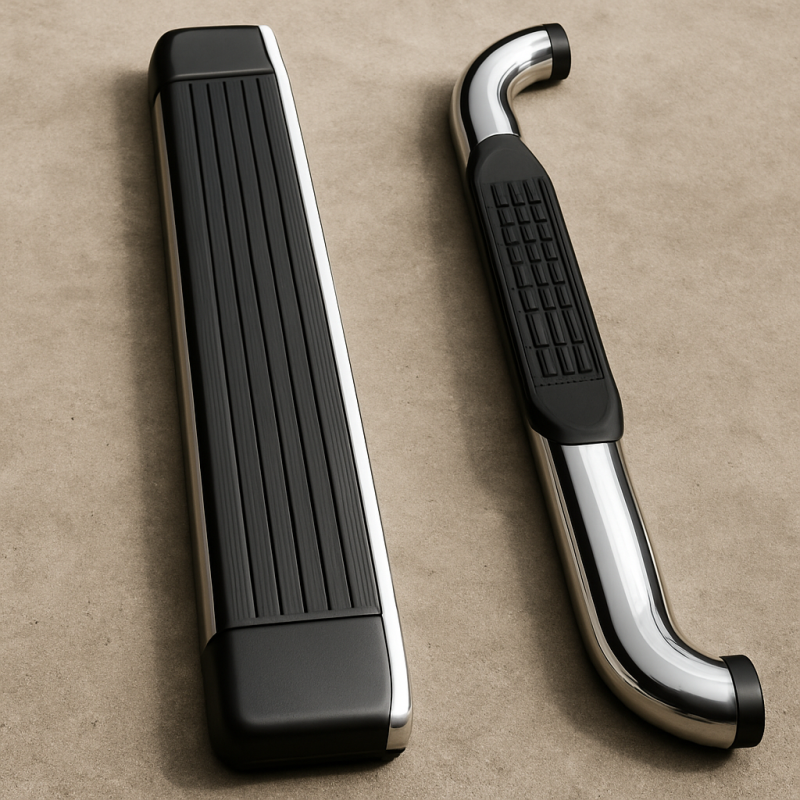
The biggest functional difference between running boards and nerf bars is the stepping surface. This single factor drives most buying decisions, so let's compare it directly.
| Feature | Running Boards | Nerf Bars |
|---|---|---|
| Step Width | 5–7 inches (full flat surface) | 3–4 inch tube + small step pads |
| Step Length | Full cab length (continuous) | Full cab length, but usable step pads only at door openings |
| Grip Surface | Textured rubber or ribbed aluminum across entire board | Small rubber or textured pads at step points |
| Foot Placement | Easy — large target area | Requires more precision, especially in dark or wet conditions |
| Weight Capacity | 300–400 lbs typical | 250–350 lbs typical |
Running boards win the stepping-surface comparison decisively. A 6-inch-wide flat platform is simply easier to use than a round tube with a small pad. This matters most for:
- Children and elderly passengers: A wide, flat surface is safer and more intuitive.
- Wet or icy conditions: More surface area means more grip contact.
- Heavy boots or work footwear: Larger soles need a larger platform.
- Night entry: You can step onto a running board without looking; nerf bar pads require a glance down.
Nerf bars aren't uncomfortable — millions of truck owners use them daily without complaint. But if ease of entry is your top priority, running boards have a clear advantage. Products like the COMNOVA 6-Inch Running Boards offer that full-width stepping surface with textured grip across the entire length of the cab.
COMNOVA 6 Inches Running Boards for Chevy Silverado Crew Cab
A 6-inch-wide running board that delivers the full flat stepping surface advantage discussed above. Compatible with 2019–2026 Silverado and Sierra crew cabs.
Check Price On AmazonIf you click this link and buy, we earn a commission at no additional cost to you.

Durability and Materials
Both running boards and nerf bars are built to handle years of abuse, but the materials and construction differ in ways that affect long-term performance.
Running board materials:
- Aluminum: Lightweight, rust-resistant, and the most popular choice. Powder-coated aluminum boards resist corrosion even in salt-belt states.
- Stainless steel: Heavier but extremely durable. Chrome or polished stainless resists rust well but shows scratches more easily.
- ABS plastic with steel frame: Budget-friendly option. The plastic surface resists dents and scratches, but the mounting frame is the structural weak point.
Nerf bar materials:
- Mild steel (powder-coated): Most common. Durable and affordable, but the powder coat can chip on trails, leading to surface rust.
- Stainless steel: Premium option that resists corrosion naturally. Polished stainless nerf bars maintain their look for years.
- Aluminum tubing: Less common for nerf bars but available. Lighter weight at the cost of some rigidity.
| Durability Factor | Running Boards | Nerf Bars |
|---|---|---|
| Rust Resistance | Excellent (aluminum models) | Good to Excellent (depends on finish) |
| Impact Resistance | Moderate — flat surface can dent | High — tubular design deflects impacts |
| Trail Damage Risk | Higher — wider profile catches rocks | Lower — narrow tube clears obstacles better |
| Longevity | 5–10 years typical | 5–10 years typical |
For truck owners who regularly hit trails or drive through rough terrain, nerf bars have an edge. Their tubular shape deflects rocks and debris rather than catching them flat. Running boards sit wider and lower, making them more vulnerable to trail damage. For a solid stainless steel option that handles both daily driving and occasional abuse, the Auto Dynasty Stainless Steel Nerf Bars offer chrome-finished tubing designed for crew cab trucks.
Aesthetics and Truck Style
Let's be honest — looks matter. Many truck owners choose side steps based on appearance first and functionality second. Running boards and nerf bars create very different visual effects on your truck.
Running boards create a clean, refined look. They fill the gap between the cab and the ground with a smooth, continuous line. This works especially well on:
- Daily drivers and family trucks: Running boards add a polished, OEM-like appearance.
- Work trucks: The utilitarian look matches a professional image.
- Stock-height trucks: Boards complement the factory stance without looking oversized.
Nerf bars create a rugged, sporty look. The tubular profile adds visual aggression and pairs naturally with other exterior upgrades. They work best on:
- Lifted trucks: Round bars complement bigger tires and leveling kits.
- Off-road builds: The motorsport-inspired tube design looks at home next to bull bars and grille guards.
- Blacked-out builds: Matte black nerf bars integrate seamlessly with dark trim packages.
There's also a middle ground worth mentioning: drop-step nerf bars. These combine a tubular mounting bar with a wider drop-down step pad, splitting the difference between nerf bar aesthetics and running board functionality. The Tyger Auto LanderX Drop Step is a popular example — it gives you the slim profile of a nerf bar with a more generous stepping surface at each door.
Your truck's overall build direction should guide this choice. If you're adding fender flares and aggressive tires, nerf bars will match the theme. If you're keeping things clean and practical, running boards are the better visual fit.
Tyger Auto LanderX Drop Step Running Board for Silverado/Sierra
The best of both worlds — a drop-step design that combines nerf bar aesthetics with a generous stepping surface. Ideal for lifted trucks that want style and function.
Check Price On AmazonIf you click this link and buy, we earn a commission at no additional cost to you.

Price Comparison and Value
Budget is always a factor. Here's how running boards and nerf bars compare across different price tiers.
| Price Tier | Running Boards | Nerf Bars |
|---|---|---|
| Budget ($80–$150) | Basic ABS/steel boards, decent function | Mild steel tubes, powder-coated, basic pads |
| Mid-Range ($150–$300) | Aluminum boards, textured grip, good fit | Stainless or heavy-gauge steel, larger step pads |
| Premium ($300–$500+) | OEM-style, integrated lighting, auto-retract | Polished stainless, wheel-to-wheel, premium pads |
At the budget level, nerf bars tend to offer better value. A basic round-tube nerf bar at $100 will look decent and last several years. Budget running boards at the same price often use thinner materials that flex underfoot.
At the mid-range level, running boards catch up. This is where you'll find the best combination of quality and price for either option. Products like the AUTOSAVER88 6-Inch Running Boards for Ram 1500 deliver aluminum construction and wide stepping surfaces at competitive prices. For a complete roundup of top options at every price point, check out our guide to the best running boards for trucks.
At the premium level, running boards pull ahead in features. Power-retractable boards, integrated LED courtesy lights, and auto-deploying mechanisms add real functionality that premium nerf bars can't match.
- Best budget value: Nerf bars — more visual impact per dollar.
- Best mid-range value: Tie — both offer excellent quality around $150–$250.
- Best premium value: Running boards — powered features justify the higher price.
AUTOSAVER88 6 Inches Running Boards for Dodge Ram 1500 Crew Cab
Aluminum construction with a wide stepping surface at a competitive mid-range price. A strong running board option for Ram 1500 owners prioritizing daily comfort.
Check Price On AmazonIf you click this link and buy, we earn a commission at no additional cost to you.

Installation Difficulty
Good news: both running boards and nerf bars are among the easiest truck accessories to install yourself. Most models use the same factory mounting points on your rocker panels.
What you'll need for either option:
- Socket wrench set: 10mm, 13mm, and 17mm are most common.
- Torque wrench: For proper bolt tightening per manufacturer specs.
- Jack and jack stands: Optional but helpful for ground clearance.
- Tape measure: To verify bracket alignment before final tightening.
Running board installation:
- Time: 30–60 minutes per side.
- Difficulty: Easy. Most kits include vehicle-specific brackets that bolt directly to existing holes.
- Weight: Running boards are heavier (20–35 lbs each), so having a second person helps during lifting and alignment.
- Common issue: Ensuring even spacing along the entire length — boards are long and need to be level.
Nerf bar installation:
- Time: 20–45 minutes per side.
- Difficulty: Easy. Fewer brackets since the tube design is self-supporting.
- Weight: Lighter than running boards (15–25 lbs each), manageable solo.
- Common issue: Step pad alignment — make sure each pad centers on the door opening.
Neither option requires drilling on most modern trucks. If your truck already has factory mounting points (most 2010+ trucks do), it's a true bolt-on job. The AUTOSAVER88 Aluminum Nerf Bars for Silverado include all hardware and vehicle-specific brackets in the box, making it a straightforward afternoon project.
Side Protection: Which Guards Better?
Some truck owners want side steps that double as rocker panel protection. Rocks, trail debris, parking lot door dings, and road spray can all damage your truck's lower body panels. How do running boards and nerf bars compare as protective accessories?
Running boards as protection:
- Coverage: Excellent. The wide, flat profile shields a large portion of the rocker panel from road debris and spray.
- Parking lots: Running boards absorb shopping cart hits and car door dings that would otherwise dent your rocker panel.
- Limitation: The flat underside can trap moisture and road salt against the rocker panel, potentially accelerating corrosion if not cleaned regularly.
Nerf bars as protection:
- Coverage: Moderate. The tubular design protects against direct side impacts but leaves gaps where debris can still reach the rocker panel.
- Off-road: Round tubes deflect rocks and branches more effectively than flat surfaces. They slide over obstacles rather than catching on them.
- Limitation: Smaller surface area means less coverage against road spray, salt, and fine debris.
| Protection Scenario | Running Boards | Nerf Bars |
|---|---|---|
| Rock chips from road | Excellent shield | Moderate — gaps in coverage |
| Parking lot impacts | Very good | Good |
| Trail obstacles | Risk of catching/snagging | Better — deflects and slides |
| Salt/spray protection | Good coverage but traps moisture | Less coverage but better drainage |
For daily driving and highway use, running boards provide better overall protection. For off-road use, nerf bars are the safer choice since they won't catch on rocks or stumps. If rocker panel protection is a primary concern, pair either option with quality mud flaps to block debris before it reaches the side steps.
Which Should You Choose?
After breaking down every major factor, here's a clear decision framework based on how you actually use your truck.
Choose running boards if:
- Passengers matter: You frequently carry kids, elderly family members, or anyone who needs easy entry.
- Daily comfort: You get in and out of your truck dozens of times per day for work.
- Clean aesthetic: You want an OEM-like, polished appearance.
- Rocker protection: You want maximum coverage against road debris on highways.
- Features: You're interested in LED lighting or power-retractable options down the road.
Choose nerf bars if:
- Off-road use: You drive trails regularly and need a profile that won't snag on obstacles.
- Rugged style: You're building an aggressive-looking truck with lifts, flares, and bumper guards.
- Budget-conscious: You want a solid, good-looking option under $150.
- Solo driver: You rarely carry passengers and mainly want the look plus occasional stepping help.
- Weight savings: Every pound counts for your build, and nerf bars are lighter.
Consider drop-step nerf bars if:
- You want nerf bar aesthetics but better stepping surface than traditional round tubes.
- You have a lifted truck where a flat running board would look out of place.
- You want a compromise without committing fully to either category.
There's no universally "better" option — it genuinely depends on your priorities. A family hauler with a stock-height Silverado gets more value from running boards. A weekend trail rig with a 3-inch lift looks and performs better with nerf bars. Match the product to the truck's purpose, and you'll be happy with the investment for years.
Related Articles
- How to Install Running Boards on Your Truck — Step-by-step installation guide relevant to both running boards and nerf bars
- Best Running Boards for Trucks — Comprehensive review of top running board options across price tiers
- Best Truck Bull Bars for Front-End Protection — Related exterior accessory that pairs well with nerf bars on off-road builds
- Best Truck Grille Guards for Front-End Protection — Another front-end protection accessory that complements nerf bar aesthetics
- Best Truck Fender Flares for Silverado & F-150 — Fender flares complement the aggressive look of nerf bar setups
- Best Truck Mud Flaps for Every Setup — Mud flaps pair with side steps to protect rocker panels from debris
Conclusion
Recommended Products
COMNOVA 6 Inches Running Boards for Chevy Silverado Crew Cab
A 6-inch-wide running board that delivers the full flat stepping surface advantage discussed above. Compatible with 2019–2026 Silverado and Sierra crew cabs.
Check Price On AmazonIf you click this link and buy, we earn a commission at no additional cost to you.
Tyger Auto LanderX Drop Step Running Board for Silverado/Sierra
The best of both worlds — a drop-step design that combines nerf bar aesthetics with a generous stepping surface. Ideal for lifted trucks that want style and function.
Check Price On AmazonIf you click this link and buy, we earn a commission at no additional cost to you.
AUTOSAVER88 6 Inches Running Boards for Dodge Ram 1500 Crew Cab
Aluminum construction with a wide stepping surface at a competitive mid-range price. A strong running board option for Ram 1500 owners prioritizing daily comfort.
Check Price On AmazonIf you click this link and buy, we earn a commission at no additional cost to you.
Frequently Asked Questions
Are running boards and nerf bars the same thing?
Do running boards or nerf bars affect gas mileage?
Can I install running boards or nerf bars myself?
Which is better for a lifted truck — running boards or nerf bars?
Do running boards protect the rocker panels?
How much weight can running boards and nerf bars hold?
Are nerf bars good in snow and ice?
How long do running boards and nerf bars last?
Affiliate Disclosure: This article contains affiliate links. If you purchase through these links, we may earn a commission at no extra cost to you.