Truck Camping Setup Guide for Beginners
Key Takeaways
- A complete truck camping setup costs between $300 and $2,000 depending on whether you choose a basic tent setup or a full platform build with accessories.
- Your truck bed size determines everything — measure your bed length before buying any gear, since most tents and platforms are size-specific.
- A quality truck bed tent and sleeping pad are the two most important first purchases, giving you a weatherproof shelter and comfortable sleep for under $250.
- Storage organization is what separates frustrating trips from enjoyable ones — invest in cargo nets, drawers, or slide-out trays before your second trip.
- Start with weekend trips close to home before committing to expensive upgrades so you learn what you actually need versus what looks cool online.
What Is Truck Camping and Why Should You Try It?
Truck camping means using your pickup truck bed as your primary shelter and sleeping space while camping. It's cheaper than RV ownership, more comfortable than ground tenting, and gives you the freedom to camp almost anywhere your truck can reach — trailheads, BLM land, beach parking lots, and backcountry roads.
The concept is simple: elevate yourself off the ground, protect yourself from weather, and keep all your gear organized in one mobile platform. Here's why truck camping has exploded in popularity:
- Cost: A full setup costs $300–$2,000 compared to $30,000+ for even a basic camper
- Flexibility: No trailer to back up, no campsite hookups needed, no size restrictions on forest roads
- Security: You're sleeping elevated off the ground, away from critters, moisture, and uneven terrain
- Simplicity: Drive to your spot, set up in 10–20 minutes, and you're home for the night
- Stealth: A truck with a topper or tent is far less conspicuous than an RV for dispersed camping
Truck camping works for weekend warriors, solo travelers, fishing and hunting trips, and even extended road trips. The key is building a setup that matches your truck, your budget, and your camping style.
You don't need a brand-new truck or thousands of dollars in gear. Many experienced truck campers started with nothing more than a foam mattress thrown in the bed and a tarp overhead. The beauty of this approach is that you can start simple and upgrade as you learn what matters to you.
What Type of Truck Works Best for Camping?
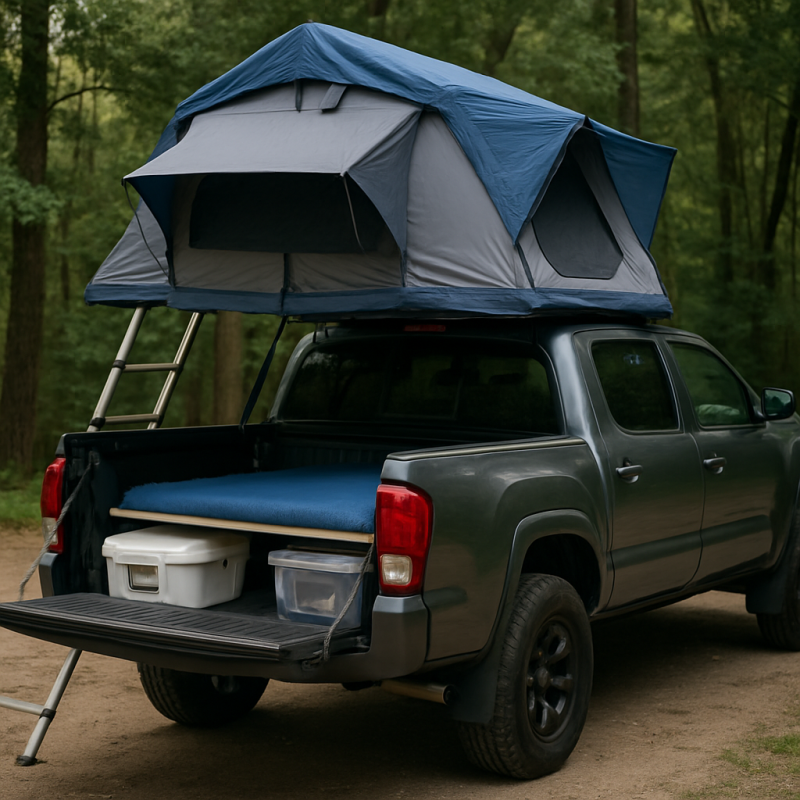
Almost any pickup truck can work for camping, but your bed size is the single most important factor. It determines which tents fit, whether you can sleep comfortably, and how much gear storage you'll have. Measure your bed before buying anything.
Here's how the three standard bed sizes compare for camping:
| Bed Size | Length | Sleep Comfort | Gear Storage | Best For |
|---|---|---|---|---|
| Short Bed | 5'5"–5'8" | Tight for tall people | Limited | Solo camping, weekend trips |
| Standard Bed | 6'4"–6'7" | Comfortable for most | Moderate | Couples, multi-day trips |
| Long Bed | 8'0"–8'2" | Spacious | Plenty | Extended trips, families |
If you have a short bed (the most common on modern trucks like the Ram 1500, F-150 crew cab, and Silverado), you can still camp comfortably. The trick is using your tailgate as an extension — most truck bed tents include a tailgate flap that adds 2–3 feet of usable space.
- 4WD vs 2WD: Four-wheel drive opens up forest roads and dispersed camping spots that 2WD trucks can't reach safely
- Payload capacity: Check your truck's payload rating — a sleeping platform, gear, and passengers add up fast
- Bed liner: A quality bed liner protects your truck from camping gear scratches and makes cleanup easier
- Tonneau cover compatibility: Some camping setups work with an existing tonneau cover, others require removal
Don't let your truck's size discourage you. The TFL Offroad community is full of creative setups for every truck size, from Mavericks to Super Duties.
What Essential Gear Do You Need to Get Started?
A beginner truck camping setup breaks down into four categories: shelter, sleep system, storage, and comfort. You don't need everything at once — start with shelter and sleep, then add storage and comfort upgrades after your first few trips.
Shelter — your first priority:
- Truck bed tent: The most popular option for beginners. Sets up in 10–15 minutes, costs $150–$350, and gives you a fully enclosed, weatherproof sleeping space. Check out our top-rated truck bed tents for specific recommendations.
- Truck canopy/topper: A permanent hard shell over your bed. More expensive ($800–$3,000) but provides year-round protection and a more finished look. Great if you want to use your truck for both daily driving and camping.
- Tarp setup: The budget option. A quality tarp and some paracord can create a rain cover for under $50, though it won't keep out bugs or wind.
Sleep system — don't cheap out here:
- Air mattress or sleeping pad: A truck-specific air mattress is shaped to fit your bed's wheel wells and contours
- Sleeping bag: Choose based on the lowest temperatures you'll encounter — a 30°F bag covers three-season use
- Pillow: A compressible camping pillow makes a huge difference over a stuffed jacket
Storage basics:
- Cargo net or organizer: Keeps gear from sliding around while driving
- Plastic bins: Weatherproof and stackable — better than duffel bags for truck camping
- Headlamp: Hands-free lighting for setup and nighttime trips
The REI truck camping guide recommends starting with these basics and upgrading after you identify what your personal setup is missing.
How Do You Choose Between a Tent, Topper, or Platform?
Your shelter choice is the biggest decision you'll make, and it affects everything else in your setup. Each option has clear trade-offs in cost, convenience, comfort, and versatility. Here's an honest breakdown:
| Feature | Truck Bed Tent | Canopy/Topper | Sleeping Platform |
|---|---|---|---|
| Cost | $150–$350 | $800–$3,000 | $200–$800 (DIY–premade) |
| Setup Time | 10–15 minutes | Permanent install | One-time build |
| Weather Protection | Good (3-season) | Excellent (4-season) | Needs tent or topper |
| Daily Driving | Remove when not camping | Always on | Can be removable |
| Gear Security | Minimal | Lockable | Under-platform storage |
| Best For | Beginners, budget setups | Frequent campers | Comfort-focused builds |
For most beginners, a truck bed tent is the best starting point. It's affordable, requires no permanent modifications, and lets you test whether truck camping is right for you before investing more. The Guide Gear Truck Bed Tent is a solid full-size option with waterproof construction and easy setup.
If you want something with an awning for shade while cooking or hanging out, the Pickup Truck Tent with Awning Shade adds covered outdoor space — a huge quality-of-life upgrade in sun or light rain.
A canopy or topper makes sense if you plan to camp regularly and want lockable, weatherproof storage year-round. Pair it with a sleeping platform for the most comfortable setup — you sleep on top while storing all your gear underneath.
Guide Gear Truck Bed Tent
A waterproof, full-size truck bed tent that's easy to set up and built for three-season camping. Great entry point for beginners who want a reliable shelter without spending a fortune.
Check Price On AmazonIf you click this link and buy, we earn a commission at no additional cost to you.

Pickup Truck Tent with Awning Shade
Features a built-in awning for shade and rain protection outside the tent, plus PU5000mm waterproofing. Fits most popular trucks including F-150, Ram 1500, Silverado, and Tundra.
Check Price On AmazonIf you click this link and buy, we earn a commission at no additional cost to you.

How Should You Organize Storage and Cargo?
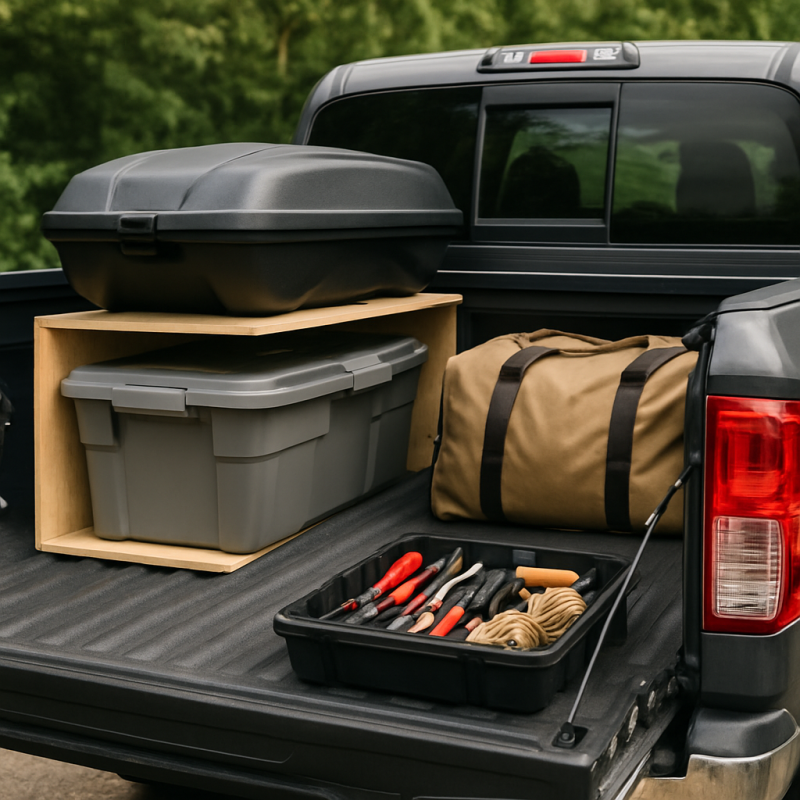
Storage is the difference between a truck camping trip that feels effortless and one where you're digging through piles of gear in the dark. Your truck bed has limited space, so vertical organization and secure storage are essential.
The golden rule of truck camping storage: everything should have a designated spot, and nothing should move while you're driving.
- Cargo nets: A quality cargo net stretched across your bed keeps bins, coolers, and bags from sliding around on rough roads. This is the cheapest and most effective storage upgrade you can make.
- Plastic bins with lids: Use clear bins so you can see contents without opening them. Stack them against the cab end of your bed.
- Drawer systems: Truck bed drawer systems are the ultimate organization upgrade. They slide out for easy access and keep everything secure underneath your sleeping surface.
- Slide-out trays: A slide-out tray gives you workbench-style access to heavy items like coolers and cooking gear without climbing into the bed.
Packing strategy for beginners:
- Heavy items forward: Place your cooler, water jugs, and toolbox closest to the cab for better weight distribution
- Frequently used items last: Pack your camp kitchen, chairs, and firewood so they're accessible without unpacking everything
- Keep a "go bag" in the cab: Headlamp, phone charger, snacks, rain jacket, and a first-aid kit should always be within reach
- Separate dirty from clean: Use a dedicated bin or dry bag for dirty clothes and muddy boots
A rubber bed mat underneath everything prevents gear from sliding on bare metal and protects your bed from scratches. It's a $40 investment that pays for itself immediately.
How Much Does a Truck Camping Setup Cost?
A complete truck camping setup can cost anywhere from $300 to over $2,000, depending on how far you take it. The good news is that even the budget tier gets you out camping comfortably — you don't need to spend a fortune to start.
Here's what to expect at each price tier:
| Budget Tier | Total Cost | What You Get |
|---|---|---|
| Starter ($150–$400) | ~$300 | Truck bed tent, foam pad or basic air mattress, sleeping bag, tarp, cargo net |
| Mid-Range ($400–$1,000) | ~$700 | Quality tent with awning, truck-fit air mattress, LED lights, storage bins, bed mat, camp kitchen basics |
| Premium ($1,000–$2,000+) | ~$1,500 | Canopy/topper, sleeping platform with drawers, quality mattress pad, solar panel, full camp kitchen, awning |
Where to spend and where to save:
- Spend on: Sleep system (mattress + sleeping bag) — a bad night's sleep ruins the whole trip
- Spend on: Shelter waterproofing — getting wet at 2 AM is miserable and potentially dangerous
- Save on: Cooking gear — a basic camp stove and pot set work just as well as expensive kits
- Save on: Lighting — battery-powered LED string lights from any discount store work great
- Save on: Furniture — you don't need a camp chair on your first trip
For beginners wanting a solid reference before hitting the road, the RV Camping Guide for Beginners covers campsite setup fundamentals and budgeting that apply to truck camping too.
Compare this to other camping styles: a basic overlanding rig costs $5,000–$15,000, a used truck camper runs $3,000–$10,000, and even a simple teardrop trailer starts at $5,000. Truck bed camping gives you 80% of the experience at 10% of the cost.
RV Camping Guide for Beginners
A practical reference book covering campsite setup, maintenance, and budgeting fundamentals that translate directly to truck camping. Helpful for first-timers who want a structured learning approach.
Check Price On AmazonIf you click this link and buy, we earn a commission at no additional cost to you.

What Mistakes Do Beginners Make with Truck Camping?
Every truck camper makes mistakes on their first few trips. The most common ones are preventable with basic planning — here's what to watch out for so you don't learn these lessons the hard way.
- Not testing your setup at home: Set up your tent, inflate your mattress, and actually sleep in your truck in your driveway before hitting a remote campsite. You'll discover fit issues, comfort problems, and missing items while you can still fix them.
- Ignoring condensation: Your body produces moisture overnight, and in an enclosed truck bed, that moisture has nowhere to go. Crack a window, use a vent in your tent, or add a small battery fan. Condensation soaks sleeping bags and creates mildew.
- Buying the wrong bed size gear: Truck bed tents and air mattresses are size-specific. A "full-size" tent won't fit a mid-size truck. Always measure your bed length and width — don't trust the manufacturer label on your truck.
- Forgetting about temperature drops: Sleeping in a metal truck bed amplifies cold. Temperatures at elevation or near water can drop 20°F below daytime highs. Insulate underneath your sleeping pad — an R-value of 3+ is recommended for three-season use.
- Overloading with gear: Your first instinct is to pack everything. Fight it. You need far less than you think, and excess gear makes your bed cramped and disorganized.
Safety mistakes to avoid:
- Never run your engine for heat while sleeping — carbon monoxide poisoning is a real risk, even with windows cracked
- Park on level ground — sleeping on a slope is miserable and can cause your truck to roll if not properly secured
- Tell someone your plans — always share your location and expected return date when dispersed camping
- Check local regulations — the Bureau of Land Management website lists rules for dispersed camping on public lands
The best advice for beginners: start with short trips close to home. A Friday-to-Sunday trip within two hours of your house lets you troubleshoot your setup without being stranded far from resources.
What Should Your First Trip Checklist Look Like?
Your first truck camping trip should be simple, close to home, and focused on testing your setup rather than covering big miles. Here's a practical checklist organized by priority so you can pack confidently.
Must-have essentials:
- Shelter: Truck bed tent (tested and practiced at home) or topper
- Sleep system: Air mattress or pad, sleeping bag rated 10°F below expected low, pillow
- Lighting: Headlamp (hands-free is non-negotiable), backup flashlight or lantern
- Water: 1 gallon per person per day minimum, refillable water bottles
- Food: Simple meals — sandwiches, canned goods, trail mix for the first trip
- First aid kit: Basic kit plus any personal medications
Important but not critical:
- Camp stove and fuel: A single-burner propane stove handles most meals
- Cooler with ice: Keep perishables cold for up to 48 hours
- Folding chair and small table: Nice for comfort, not essential
- Trash bags: Pack out everything — leave no trace
- Basic tools: Multi-tool, duct tape, zip ties, extra rope
Pre-trip truck checks:
- Check tire pressure including your spare
- Top off fluids — oil, coolant, washer fluid
- Verify your jack and lug wrench are in the truck
- Charge your phone and bring a car charger or power bank
- Download offline maps for your area — cell service is unreliable in camping areas
As the Leave No Trace Center emphasizes, responsible camping means packing out all waste, respecting wildlife, and leaving your campsite better than you found it. This applies whether you're in a national forest or an informal pulloff on a dirt road.
After your first trip, make notes about what worked, what didn't, and what you wish you'd brought. That list becomes your personalized upgrade roadmap for future trips.
Van Life for Beginners
While focused on van conversions, this guide covers mobile living essentials like water systems, power setups, and space optimization that apply directly to advanced truck camping builds.
Check Price On AmazonIf you click this link and buy, we earn a commission at no additional cost to you.

Related Articles
- Best Truck Bed Tents for Camping — Recommended in the essential gear section for readers ready to choose a specific truck bed tent
- Best Truck Bed Air Mattresses for Camping — Linked when discussing sleep systems and truck-specific air mattress options
- Best Truck Bed Canopies and Toppers — Referenced in the shelter comparison section for readers considering a permanent topper
- Best Truck Bed Sleeping Platforms for Camping — Linked in the shelter comparison section as the comfort-focused upgrade option
- Best Truck Bed Cargo Nets — Referenced in the storage section as an essential cargo management tool
- Best Truck Bed Drawers for Storage — Linked in storage organization section as a premium storage upgrade
- Best Truck Bed Slide Out Trays — Referenced for easy access to heavy gear like coolers and cooking equipment
- Best Truck Bed Mats for Every Pickup — Mentioned in storage section as a protective layer underneath camping gear
- Best Truck Bed Liners for Protection — Referenced in the truck selection section for protecting the bed from gear damage
Conclusion
Recommended Products
Guide Gear Truck Bed Tent
A waterproof, full-size truck bed tent that's easy to set up and built for three-season camping. Great entry point for beginners who want a reliable shelter without spending a fortune.
Check Price On AmazonIf you click this link and buy, we earn a commission at no additional cost to you.
Pickup Truck Tent with Awning Shade
Features a built-in awning for shade and rain protection outside the tent, plus PU5000mm waterproofing. Fits most popular trucks including F-150, Ram 1500, Silverado, and Tundra.
Check Price On AmazonIf you click this link and buy, we earn a commission at no additional cost to you.
RV Camping Guide for Beginners
A practical reference book covering campsite setup, maintenance, and budgeting fundamentals that translate directly to truck camping. Helpful for first-timers who want a structured learning approach.
Check Price On AmazonIf you click this link and buy, we earn a commission at no additional cost to you.
Van Life for Beginners
While focused on van conversions, this guide covers mobile living essentials like water systems, power setups, and space optimization that apply directly to advanced truck camping builds.
Check Price On AmazonIf you click this link and buy, we earn a commission at no additional cost to you.
Frequently Asked Questions
Can you truck camp in any pickup truck?
How much does it cost to set up a truck for camping?
Is truck camping safe?
How do you stay warm truck camping?
Do you need a truck bed tent or can you use a regular tent?
How do you deal with condensation in a truck bed?
Where can you legally truck camp for free?
What's better for truck camping: a tent or a topper?
Affiliate Disclosure: This article contains affiliate links. If you purchase through these links, we may earn a commission at no extra cost to you.