How to Organize Your Truck Bed
Key Takeaways
- Start by assessing what you haul most often — your organization system should match your actual usage, not a generic setup.
- A crossover tool box combined with a cargo net handles 80% of everyday truck bed storage needs for under $200.
- Divide your truck bed into zones (front, middle, rear) to keep heavy items forward and frequently accessed items near the tailgate.
- Slide-out cargo trays eliminate the need to climb into your bed and protect gear from weather when paired with a tonneau cover.
- Securing your organization accessories properly with universal mounting kits prevents shifting, rattling, and damage while driving.
Assess Your Hauling Needs First
Before you buy a single accessory, spend a week paying attention to how you actually use your truck bed. The biggest mistake people make is buying organization gear that doesn't match their real-world usage.
- Daily haulers: If you carry tools, equipment, or supplies every day, you need fixed storage like tool boxes and drawer systems that stay mounted permanently.
- Weekend warriors: If your bed is empty Monday through Friday but loaded on weekends, you need flexible solutions like cargo nets and removable dividers.
- Mixed use: If you alternate between hauling sheets of plywood and picking up groceries, you need a modular system that adapts quickly.
Grab a notebook and answer these questions:
- What do I haul most frequently? (Tools, materials, gear, groceries)
- Do I need to access items from the side, or only from the tailgate?
- Do my items need weather protection?
- How often do I need the full bed length clear for large loads?
Your answers determine which accessories make sense. A contractor who needs daily access to power tools has completely different needs than someone who occasionally hauls camping gear. Don't copy someone else's setup — build one that fits your life.
Also consider your truck's bed length. Short beds (5'5"-5'8") have less room for fixed storage, so every inch matters. Standard beds (6'5") and long beds (8') give you more flexibility to dedicate zones to permanent accessories.
Tools and Materials You'll Need
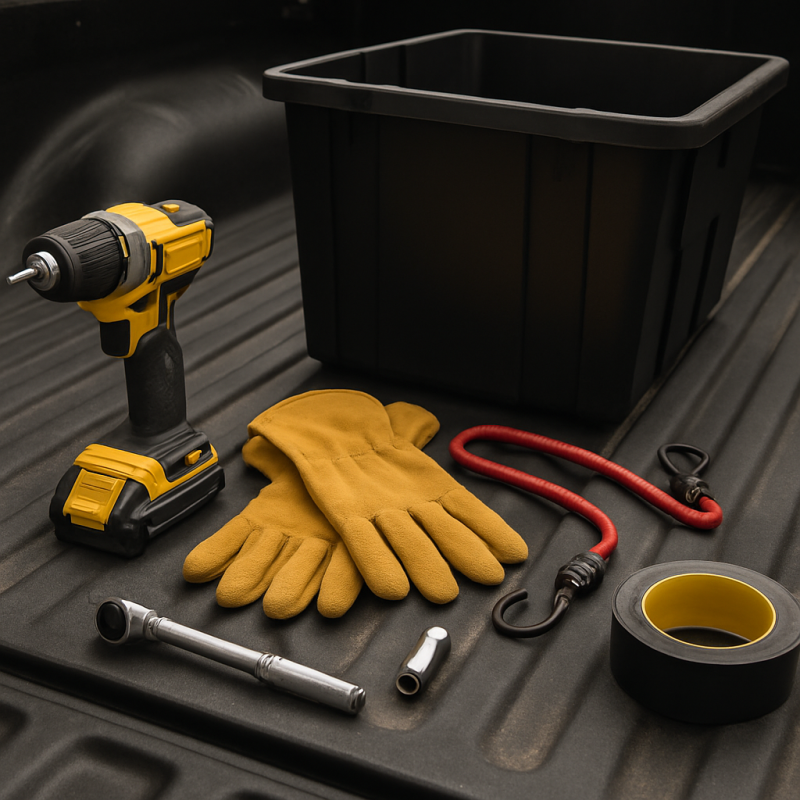
Organizing your truck bed is a straightforward project that takes 1-3 hours depending on complexity. Here's what you'll need:
- Socket wrench set: 10mm, 13mm, and 17mm sockets cover most mounting hardware
- Tape measure: for measuring bed dimensions and accessory placement
- Drill with bits: only if you're mounting permanent accessories (many solutions are no-drill)
- Rubbing alcohol and clean rags: for cleaning bed rails and surfaces before mounting
- Painter's tape: for marking positions before committing to a layout
- Level: ensures tool boxes and trays sit flat
For the organization accessories themselves, your budget determines your approach:
- Budget ($50-$150): Cargo net, tie-down anchors, and a bed mat
- Mid-range ($150-$400): Crossover tool box, cargo net, and bed dividers
- Premium ($400-$1,000+): Slide-out cargo tray, tool box, and weatherproof storage bins
If you're installing a tool box, you'll want a reliable truck tool box mounting kit with J-hooks and fastening nuts to secure it properly to your bed rails. Universal kits fit most pickup trucks and eliminate the need for drilling.
A quality bed mat is also worth adding early — it prevents cargo from sliding and protects your bed surface from scratches.
Create a Three-Zone Layout
The most effective truck bed organization follows a three-zone system. Think of your bed as three distinct areas, each with a specific purpose.
- Front zone (cab end): Reserved for heavy, fixed storage like crossover tool boxes or storage chests. Placing weight here improves handling and keeps items away from the tailgate where they could fall out.
- Middle zone: Your flexible space. Use modular bins, cargo nets, or slide-out trays here. This zone adapts based on what you're hauling that day.
- Rear zone (tailgate end): Keep frequently accessed items here. Groceries, coolers, bags — anything you grab regularly goes near the tailgate for easy reach.
Use painter's tape to mark these zones on your bed rails before installing anything. Stand at your tailgate and visualize your typical load. Can you reach the items you need most? Is the heavy stuff forward?
Weight distribution matters. Trucks handle best when cargo weight sits between the axles. Loading everything against the tailgate shifts weight behind the rear axle, which can cause steering issues — especially in rain or snow.
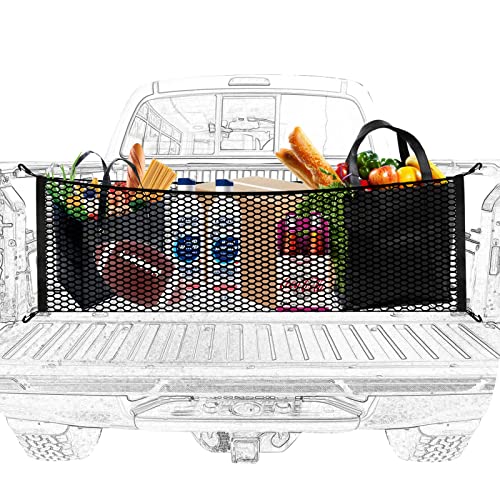
For the middle zone, a cargo storage elastic mesh net is one of the most versatile solutions. It stretches to hold oddly shaped items, collapses flat when not in use, and costs a fraction of rigid organizers. Check out our top-rated cargo nets for more options.
If your budget allows, a slide-out cargo tray in the middle zone is a game-changer — you can access everything without climbing into the bed.
Truck Bed Cargo Net with Hooks
Elastic mesh cargo net that stretches to secure groceries, bags, and gear. Hooks attach to bed anchor points in seconds and the net folds flat when not in use.
Check Price On AmazonIf you click this link and buy, we earn a commission at no additional cost to you.
Install a Crossover Tool Box
A crossover tool box is the foundation of most truck bed organization systems. It mounts behind the cab, uses dead space near the bulkhead, and provides secure, weatherproof storage without eating into your usable bed length.
Here's how to install one:
- Clean your bed rails with rubbing alcohol to remove dirt and grease. This ensures mounting clamps grip properly.
- Position the tool box centered on the bed rails. Have a helper hold it in place while you check alignment from the tailgate.
- Attach the mounting clamps. Most universal mounting kits use J-hooks that loop under the bed rail lip. Slide the J-hooks into position, then hand-tighten the fastening nuts.
- Check for level. Place a level on top of the tool box. Adjust clamp positions if needed.
- Torque everything down. Tighten all nuts firmly with a socket wrench. The box should not shift when you push on it from any direction.
- Test the lid. Open and close it several times. Verify the seal sits flush — gaps let in water.
A universal aluminum mounting kit with J-hooks makes this a no-drill installation that takes about 20 minutes. The aluminum won't rust, and the universal design fits Ford, Chevy, Ram, Toyota, and Nissan trucks.
For a deeper dive on choosing the right box, browse our best truck bed tool boxes roundup.
Pro tip: Line the inside of your tool box with a rubber mat or foam padding. This prevents tools from rattling on bumpy roads and protects the box's finish.
Upgraded Truck Tool Box Mounting Kit
Universal aluminum J-hook mounting kit with fastening nuts for no-drill tool box installation. Fits all major truck brands and won't rust or corrode.
Check Price On AmazonIf you click this link and buy, we earn a commission at no additional cost to you.

Secure Loose Cargo With Nets and Tie Downs
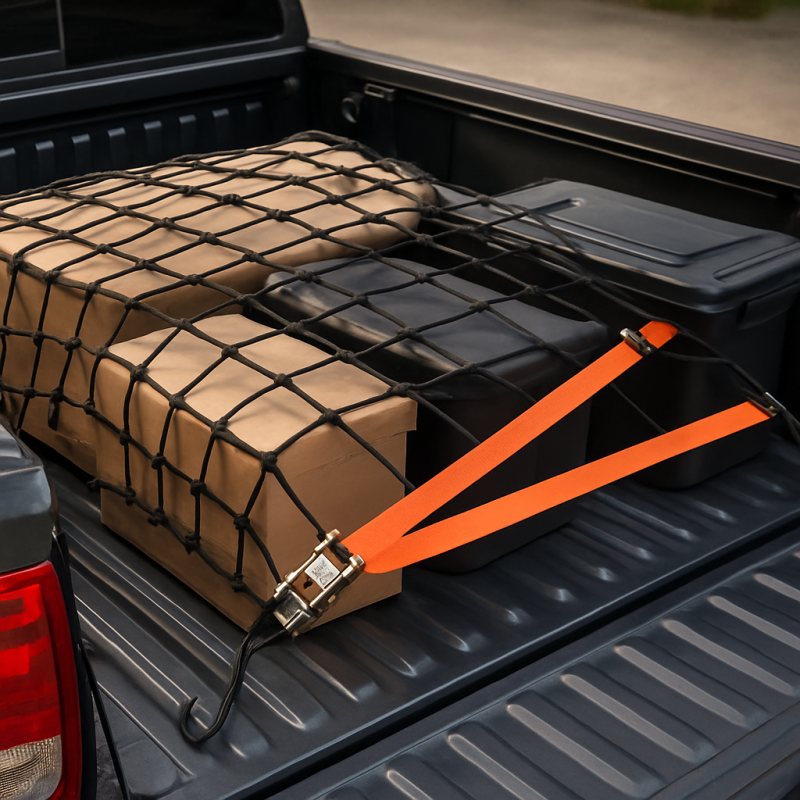
Even the best zoning strategy fails if your cargo isn't secured. Loose items become projectiles during hard braking, and shifting loads damage both your cargo and your truck bed.
You have two primary options for securing loose cargo:
- Cargo nets: Best for irregularly shaped items, bags, and lighter loads. They stretch to accommodate different sizes and fold flat when not in use.
- Tie-down anchors and straps: Best for heavy, solid items like coolers, toolboxes, and equipment cases. Ratchet straps provide the most holding force.
For everyday hauling — groceries, sports gear, bags — a quality cargo net mounted to your bed's stake pockets or anchor points handles the job. Hook-style nets attach in seconds and remove just as fast.
For heavier loads, you need proper truck bed tie downs rated for your cargo weight. Most factory tie-down points are rated for 200-300 pounds each. Aftermarket anchors can handle 500+ pounds per point.
Common mistakes to avoid:
- Over-tightening ratchet straps: This can crush boxes and dent soft items. Snug is enough — you just need to prevent movement.
- Using bungee cords for heavy items: Bungees stretch and release. They're fine for tarps, not for securing a generator.
- Ignoring vertical movement: Straps that only prevent side-to-side shifting won't stop items from bouncing up on rough roads. Cross-strap in an X pattern for full restraint.
Combine a cargo net in the rear zone with ratchet straps in the middle zone for the most versatile setup. This covers both quick grocery runs and serious hauling days.
Add a Slide-Out Cargo Tray for Easy Access
If you're tired of climbing into your truck bed or leaning over the side to reach items, a slide-out cargo tray solves the problem permanently. These trays mount to your bed floor and extend past the tailgate, bringing everything within arm's reach.
- Full-extension trays: Slide out 100% of their length, giving you access to items at the very front of the bed.
- Partial-extension trays: Slide out 65-75%, which is enough for most tasks and costs less.
- Weight capacity: Most trays handle 400-800 pounds of evenly distributed weight.
The Rough Country Slide-Out Cargo Tray is a solid choice for beds 5'7" and longer. It's built from heavy-duty polyethylene with UV protection, so it won't crack or fade. The low-profile design still allows tailgate access when the tray is retracted.
Installation typically takes 30-60 minutes:
- Remove any existing bed mat or liner from the floor area
- Position the tray rails along the bed walls, aligning with factory mounting points
- Bolt the rail brackets to the bed using the included hardware
- Slide the tray onto the rails and test the extension mechanism
- Adjust the rail spacing if the tray binds or sticks
One important consideration: Slide-out trays add 2-4 inches of height to your bed floor. If you regularly haul tall items or stack materials high, factor this into your calculations. Pairing a tray with a tonneau cover creates a secure, accessible storage vault that keeps everything dry and organized.
Rough Country Slide-Out Truck Bed Cargo Tray
Heavy-duty polyethylene slide-out tray with UV protection for beds 5'7" and longer. Makes every item in your truck bed accessible from the tailgate without climbing in.
Check Price On AmazonIf you click this link and buy, we earn a commission at no additional cost to you.

Protect Your Bed Surface
Organization accessories are only as good as the surface they sit on. A bare metal bed dents, scratches, and rusts — especially under heavy tool boxes and sliding cargo.
You have three main options for bed protection:
- Bed liners (spray-in): Permanent, textured coating that prevents rust and adds grip. Professional installation runs $400-$600. Best for trucks that see heavy daily use.
- Bed liners (drop-in): Rigid plastic shells that snap into your bed. Easy to remove but can trap moisture underneath. Budget-friendly at $150-$300.
- Bed mats: Thick rubber mats that lay on the bed floor. No installation needed, easy to remove for cleaning, and cost $50-$150. Great for mixed-use trucks.
For most truck owners building an organization system, a quality bed liner provides the best foundation. The textured surface prevents cargo from sliding — even without nets or straps — and protects against scratches from tool boxes and storage bins.
If you already have a bare bed and want to install a liner yourself, a drop-in liner is the DIY-friendly option. Spray-in liners require professional equipment for a proper finish.
Don't skip this step. Even the most organized truck bed deteriorates fast without surface protection. Rust starts in scratches you can't even see, and once it begins, it spreads under your accessories where you won't notice it until the damage is serious.
A bed mat under your slide-out tray also reduces noise from vibration and prevents the tray rails from wearing through your bed's paint.
Troubleshooting Common Organization Problems
Even a well-planned truck bed setup can develop issues over time. Here are the most common problems and how to fix them.
- Tool box rattles while driving: Mounting clamps have loosened. Re-torque all fastening nuts and check that J-hooks are fully seated under the bed rail lip. Add a thin rubber gasket between the box and bed rail to dampen vibration.
- Cargo net loses tension: Elastic mesh stretches over time, especially in heat. Replace the net annually if you use it daily, or upgrade to a heavy-duty version with thicker cords.
- Slide-out tray sticks or binds: Dirt and debris in the rail channels. Clean rails with a stiff brush and apply silicone spray lubricant. Never use WD-40 — it attracts dirt and makes the problem worse over time.
- Items still slide despite bed mat: Your mat may be worn smooth. Flip it over for fresh grip, or replace it. For maximum grip, a spray-in liner outperforms any mat.
- Water pooling around accessories: Check that drain holes in your bed aren't blocked by mats or liners. Trim the mat if it covers drain channels. Ensure tool box seals are intact.
Seasonal maintenance checklist:
- Inspect all mounting hardware and re-torque bolts quarterly
- Clean bed surface and accessories with mild soap and water
- Lubricate slide-out tray rails every 3 months
- Check cargo net hooks and elastic for wear or UV damage
- Inspect bed surface underneath mats and liners for moisture or rust
For trucks exposed to harsh weather, consider adding truck bed lights so you can actually see what you're loading and unloading in the dark — because the best organization system is useless if you can't find anything at night.
Related Articles
- Best Truck Bed Cargo Nets — Detailed reviews of top cargo nets for securing loose items in your truck bed
- Best Truck Bed Mats for Every Pickup — Reviews of bed mats that prevent cargo sliding and protect your bed surface
- Best Truck Bed Tool Boxes for Pickups — Roundup of the best crossover and side-mount tool boxes for truck bed storage
- Best Truck Bed Tie Downs for Secure Hauling — Reviews of tie-down anchors and straps for securing heavy cargo
- Best Tonneau Covers for Trucks — Tonneau covers pair with organization systems to create weatherproof storage
- Best Truck Bed Liners for Protection — Bed liners protect your truck bed surface under organization accessories
- How to Install a Truck Bed Liner — Step-by-step guide for DIY bed liner installation
- Best Truck Bed Lights for Nighttime Loading — Lighting solutions for visibility when loading and organizing at night
Conclusion
Recommended Products
Rough Country Slide-Out Truck Bed Cargo Tray
Heavy-duty polyethylene slide-out tray with UV protection for beds 5'7" and longer. Makes every item in your truck bed accessible from the tailgate without climbing in.
Check Price On AmazonIf you click this link and buy, we earn a commission at no additional cost to you.
Truck Bed Cargo Net with Hooks
Elastic mesh cargo net that stretches to secure groceries, bags, and gear. Hooks attach to bed anchor points in seconds and the net folds flat when not in use.
Check Price On AmazonIf you click this link and buy, we earn a commission at no additional cost to you.
Upgraded Truck Tool Box Mounting Kit
Universal aluminum J-hook mounting kit with fastening nuts for no-drill tool box installation. Fits all major truck brands and won't rust or corrode.
Check Price On AmazonIf you click this link and buy, we earn a commission at no additional cost to you.
Frequently Asked Questions
What is the best way to organize a truck bed?
How much does it cost to organize a truck bed?
Can I organize my truck bed without drilling?
How do I keep things from sliding in my truck bed?
What size tool box fits my truck?
Do I need a tonneau cover for truck bed organization?
How do I organize a short bed truck?
How often should I maintain my truck bed organization system?
Affiliate Disclosure: This article contains affiliate links. If you purchase through these links, we may earn a commission at no extra cost to you.