How to Load a Kayak on a Truck by Yourself
Key Takeaways
- A kayak roller or load assist device eliminates the need for a second person and reduces injury risk when loading solo.
- The tailgate-slide method is the simplest solo loading technique for trucks with open beds — no special equipment required.
- Always secure your kayak with at least two cam buckle straps and a red safety flag if it extends past the tailgate.
- Proper lifting technique matters more than strength — bend at the knees, keep the kayak close to your body, and never twist your back.
- A truck bed rack elevates your kayak above the bed rails, freeing up cargo space and improving highway aerodynamics.
What Do You Need Before Loading a Kayak Solo?
Before you attempt to load a kayak on a truck by yourself, gather a few essentials. The right prep turns a stressful lift into a smooth, repeatable routine that takes under five minutes from ground to fully strapped.
- Kayak weight check: weigh your kayak or check the manufacturer spec — recreational kayaks run 35–65 lbs, touring models 50–80 lbs
- Two cam buckle straps (1" wide, 12–15 ft): ratchet straps can crush a plastic hull, so cam buckles are the standard
- Moving blanket or pool noodle: protects bed rails and the kayak hull from scratches
- Red safety flag: required by most states if the kayak extends more than 3–4 feet past the tailgate
- Non-slip gloves: wet hands and smooth polyethylene are a bad combination
If your kayak weighs over 55 lbs or your truck sits tall, add a kayak load assist roller to your kit. A device like the Codinter Kayak Roller mounts to your tailgate or bed rail with suction cups and lets you slide the kayak up without lifting the full weight overhead.
You should also check your truck bed dimensions. Short beds (5.5 ft) require the tailgate down and possibly a bed extender. Standard beds (6.5 ft) fit most kayaks with the tailgate down. Long beds (8 ft) can handle all but the longest touring kayaks with the tailgate closed.
- Time estimate: 3–5 minutes once you've practiced the technique two or three times
- Difficulty: easy with the right tools, moderate without any accessories
- Risk level: low if you use proper lifting form and secure the kayak with straps
How Do You Load a Kayak Using the Tailgate-Slide Method?
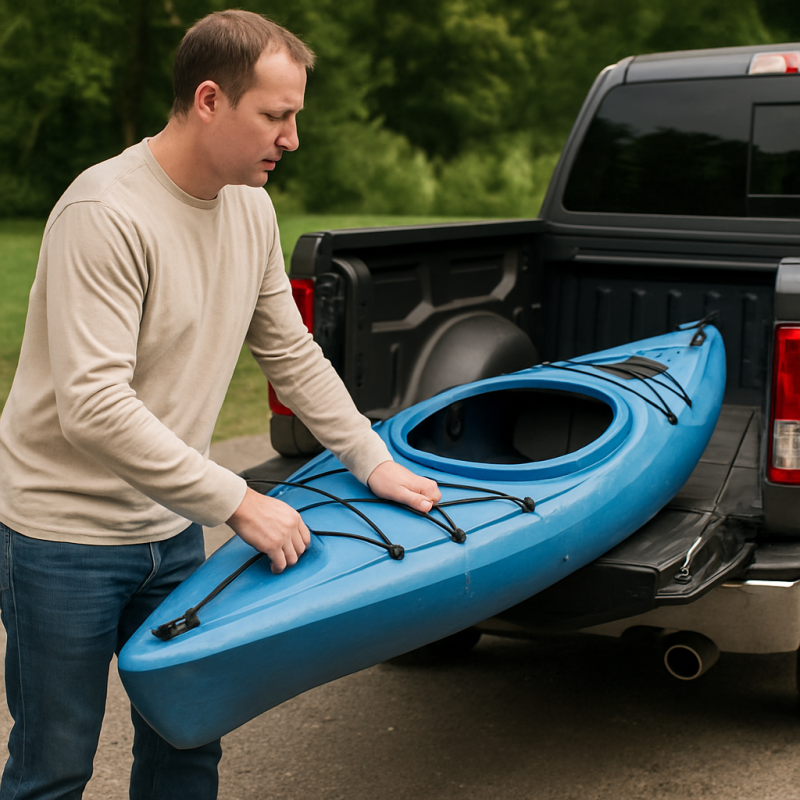
The tailgate-slide method is the simplest and most popular way to load a kayak on a truck by yourself. It requires zero special equipment — just your truck, your kayak, and a blanket to protect surfaces. Here's the step-by-step process.
- Lower the tailgate and drape a moving blanket or old towel over the edge to prevent scratches on both the tailgate and the kayak hull.
- Position the kayak on the ground behind your truck, hull-down (cockpit facing up), with the bow pointing toward the tailgate.
- Lift the bow onto the tailgate by bending at your knees, gripping the bow handle or grab loop, and walking it up until roughly one-third of the kayak rests on the tailgate.
- Walk to the stern and lift it while pushing the kayak forward into the bed. The blanket lets the hull glide smoothly without catching.
- Center the kayak in the bed and adjust position so weight distributes evenly.
This method works best for trucks with standard or long beds and kayaks under 12 feet. For short-bed trucks, the kayak will overhang the tailgate — that's normal, but you'll want to secure a red flag to the stern and consider a bed extender.
A few tips to make the slide smoother:
- Wax the hull: a quick coat of 303 Protectant or marine wax reduces friction and protects the plastic
- Use the cockpit rim: if you can't reach the bow handle, grip the cockpit rim — it's the strongest structural point
- Park on flat ground: loading on a slope adds unpredictable momentum
Can a Kayak Roller Make Solo Loading Easier?
A kayak roller is the single best investment for anyone who regularly loads a kayak on a truck by yourself. It reduces the required lifting effort by 60–70% by letting you roll the kayak into position rather than muscle it up and over the bed rail.
Here's how a roller-based loading process works:
- Attach the roller to your tailgate or rear bed rail using heavy-duty suction cups. Most rollers mount in under 30 seconds.
- Place the kayak bow onto the roller from behind the truck.
- Push from the stern — the roller spins freely, guiding the kayak smoothly into the bed with minimal effort.
- Remove the roller and close the tailgate (if the kayak fits inside the bed length).
Several quality options exist at different price points:
- Codinter Kayak Roller: heavy-duty suction cups, handles kayaks up to 200 lbs, great build quality
- Bonsing Kayak Roller: compact design, strong suction base, solid budget choice
- HUIMENG Kayak Roller: adjustable tightness and angle, anti-sideslip design, holds up to 220 lbs
Rollers are especially helpful for lifted trucks or heavier touring and tandem kayaks. If your truck bed height exceeds 30 inches from the ground, a roller transitions from "nice to have" to essential. For a comprehensive look at mounting options that keep your kayak secure during transport, check out our guide to truck kayak racks and carriers.
Codinter Kayak Roller Load Assist
Heavy-duty suction cup roller that mounts to your tailgate in seconds. Makes solo kayak loading effortless by letting you push instead of lift.
Check Price On AmazonIf you click this link and buy, we earn a commission at no additional cost to you.

What About Using a T-Loader or J-Bar for Truck Beds?
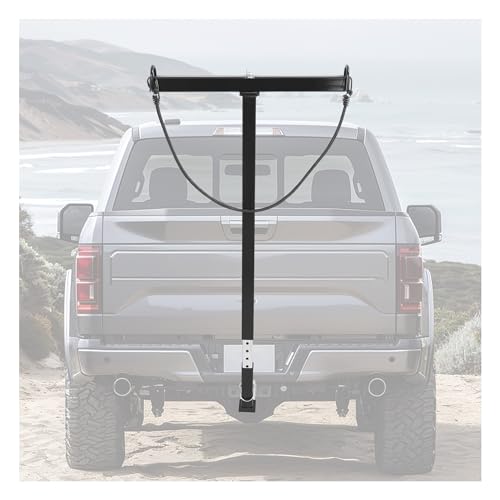
A T-loader is a purpose-built frame that bolts or clamps to your truck's hitch receiver or bed rail, creating a vertical post you lean the kayak against before tilting it into the bed. It's the most ergonomic option for heavier kayaks (60+ lbs) and taller trucks.
Here's how the T-loader method works:
- Insert the T-loader post into your hitch receiver or clamp it to the bed rail.
- Lean the kayak vertically against the padded crossbar at the top of the T-post.
- Walk the kayak base toward the truck while tilting the top into the bed.
- Slide the kayak forward until it's centered, then remove the T-loader and stow it.
The KUAFU Universal T-Load Loader is a well-reviewed option that fits most trucks and SUVs. If you prefer a more permanent setup, the KUAFU Universal Kayak Loader offers a steel construction with powder-coated finish for long-term durability.
Key considerations when choosing between a roller and a T-loader:
| Feature | Kayak Roller | T-Loader |
|---|---|---|
| Setup time | 30 seconds | 2–3 minutes |
| Best for | Light-to-medium kayaks (under 60 lbs) | Heavy kayaks (60+ lbs) |
| Truck height | Any | Best for lifted or tall trucks |
| Storage size | Compact | Bulkier (folds down) |
| Price range | $25–$50 | $50–$120 |
Either tool dramatically reduces the strain of loading a kayak on a truck by yourself. The right choice depends on your kayak weight and how high your truck bed sits.
KUAFU Universal Kayak T-Load Loader
Hitch-mounted T-loader that provides a vertical support post for tilting heavy kayaks into the bed. Ideal for lifted trucks and kayaks over 60 lbs.
Check Price On AmazonIf you click this link and buy, we earn a commission at no additional cost to you.
How Do You Secure a Kayak in a Truck Bed?
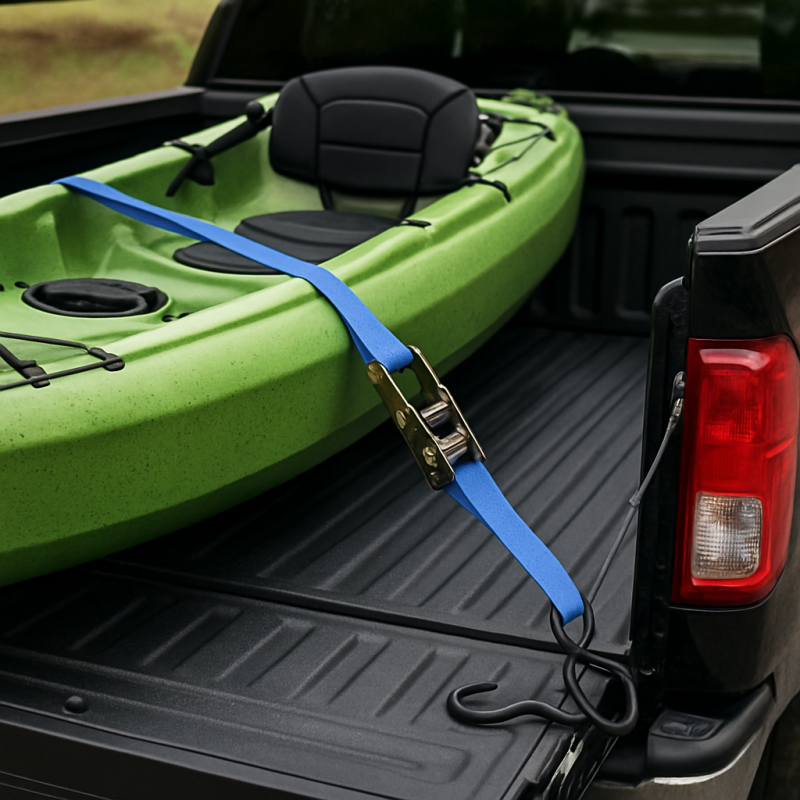
Loading the kayak is only half the job — securing it properly prevents damage, accidents, and traffic violations. An unsecured kayak can shift, fly out, or become a dangerous projectile at highway speeds. Follow these steps every time.
- Position the kayak hull-down, centered in the bed, with the heaviest end (usually the stern) closest to the cab.
- Loop two cam buckle straps over the kayak and through the bed tie-down points. Place one strap near the bow, one near the stern.
- Tighten until snug — you should be able to slip two fingers under the strap, but the kayak shouldn't shift when you push it laterally.
- Add a bow line tied to the front tow hook if the kayak extends past the tailgate.
- Attach a red flag to any overhang extending more than 3 feet past the tailgate.
Never use ratchet straps directly on a kayak hull. The mechanical advantage of a ratchet can crack or deform polyethylene and composite hulls. Cam buckle straps provide firm tension without the risk of over-tightening.
- Highway driving: check straps at every fuel stop — heat and vibration can loosen them
- Crosswinds: a kayak sitting above the bed rails acts like a sail, so a dedicated kayak rack with low-profile mounting helps reduce wind drag
- Rain: wet straps stretch slightly, so re-tighten after driving through rain
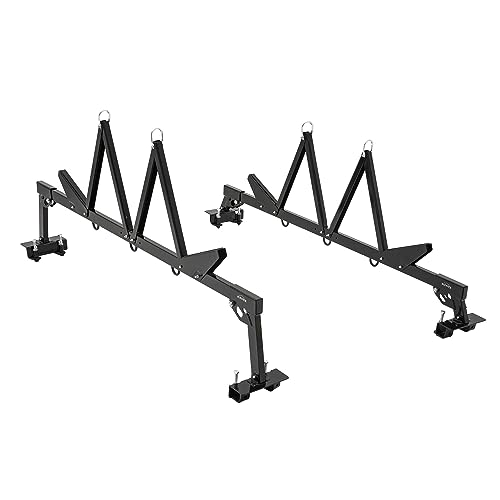
If you frequently haul both a kayak and other cargo, consider installing a Elevate Outdoor Truck Bed Kayak Rack. It lifts the kayak above the bed rails with a no-drill clamp system, freeing up the entire bed floor for coolers, tackle boxes, and camping gear.
Elevate Outdoor Truck Bed Kayak/SUP Rack
No-drill bed rack that lifts your kayak above the rails, freeing up the entire bed floor. Fits beds 54–64 inches wide and holds up to 150 lbs.
Check Price On AmazonIf you click this link and buy, we earn a commission at no additional cost to you.
What Mistakes Should You Avoid When Loading Solo?
Most solo-loading injuries and kayak damage come from rushing the process or skipping basic precautions. Avoid these common mistakes to keep yourself and your boat in good shape.
- Lifting with your back: the number-one cause of kayak-related injuries. Always squat, keep your spine neutral, and drive up with your legs. The Mayo Clinic recommends keeping the load close to your body and avoiding twisting while lifting.
- Dragging the hull on pavement: asphalt grinds through gelcoat and polyethylene fast. Always lift or use a VEVOR Kayak Cart to roll the kayak from the water to your truck.
- Loading in wind: even a 15 mph crosswind can catch a kayak like a sail. Wait for a lull, or position your truck so the wind pushes the kayak toward the bed rather than away from it.
- Forgetting to pad contact points: bare metal bed rails will scratch your kayak and create pressure points that deform the hull over time. Pool noodles cut lengthwise and zip-tied to the rails are a cheap, effective solution.
- Skipping the safety flag: a kayak overhanging the tailgate without a flag can earn you a $100+ ticket in most states.
A few more tips that experienced paddlers swear by:
- Practice at home first: do two or three dry runs in your driveway before heading to a busy boat ramp
- Load cockpit-up: a cockpit-down kayak collects rain, bugs, and road grime during transport
- Check suction cups in heat: extreme heat softens the rubber and reduces grip — re-seat roller suction cups if the truck has been sitting in direct sun
- Stow the paddle separately: don't leave it loose in the kayak cockpit where it can rattle free at speed
VEVOR Heavy Duty Kayak Cart
450 lb capacity wheeled cart with solid tires for rolling your kayak from the truck to the water. Eliminates hull-damaging dragging across pavement.
Check Price On AmazonIf you click this link and buy, we earn a commission at no additional cost to you.

How Do You Unload a Kayak from a Truck by Yourself?
Unloading is essentially the reverse of loading, but gravity is now working with you — which can be both helpful and dangerous if you're not careful. Control the slide speed to avoid dropping your kayak.
- Untie all straps and stow them so they don't tangle around your feet.
- Lower the tailgate and drape a blanket over the edge again.
- Slide the kayak rearward slowly until roughly one-third extends past the tailgate.
- Walk to the stern (now hanging off the tailgate) and lower it to the ground gently.
- Pull the rest of the kayak off the tailgate and set it hull-down on the ground or onto a kayak cart.
If you used a roller to load, reattach it for unloading too. The roller controls the slide speed and prevents the kayak from shooting off the tailgate unexpectedly.
A few unloading-specific tips:
- Wet kayaks are heavier: water trapped in the cockpit, scupper holes, or hatch compartments adds weight. Tip the kayak to drain before lifting.
- Use the kayak cart for the last mile: once the kayak is on the ground, strap it to a wheeled cart to roll it to the water instead of carrying it
- Watch your footing: boat ramps are notoriously slippery — wear shoes with non-slip soles
With practice, unloading takes 2–3 minutes. The entire round trip — load at home, drive, unload at the launch, reload after paddling, unload at home — adds roughly 15–20 minutes to your total trip time.
Should You Use a Truck Bed Rack or Carry the Kayak Flat?
Carrying a kayak flat in the bed works fine for short trips and short-bed trucks, but a dedicated truck bed rack has real advantages for frequent paddlers. The right setup depends on how often you haul and what else you carry.
Benefits of a truck bed kayak rack:
- Frees up bed space: the kayak sits above the rails, leaving the bed floor open for coolers, gear, and supplies
- Better aerodynamics: a properly positioned kayak on a rack creates less drag than one sitting in the bed catching wind
- Easier loading: many racks include built-in rollers or J-cradles that simplify solo loading
- Protects the hull: padded cradles distribute weight evenly, preventing flat spots from prolonged bed contact
Benefits of carrying flat in the bed:
- No extra cost: just straps and padding
- Lower center of gravity: more stable in crosswinds and sharp turns
- Simpler setup: no rack to install or remove
For a deep dive on the best rack options across all price ranges, our truck kayak racks and carriers guide covers the top picks for short-bed, standard, and long-bed trucks.
If you're planning a multi-day truck camping trip where you need bed space for sleeping and gear, a rack is the clear winner. For weekend day-paddlers who don't need the bed for anything else, flat carry with straps and a blanket gets the job done with zero investment.
Related Articles
- Best Truck Kayak Racks and Carriers — Comprehensive guide to kayak rack options for trucks — referenced when discussing mounting, wind resistance, and rack vs. flat carry decisions
- Best Truck Bed Air Mattresses for Camping — Linked when discussing freeing up bed space for camping gear alongside kayak transport
- Best 12V Truck Coolers for Camping — Referenced in the context of multi-day paddling and truck camping trips where bed space is at a premium
Conclusion
Recommended Products
Codinter Kayak Roller Load Assist
Heavy-duty suction cup roller that mounts to your tailgate in seconds. Makes solo kayak loading effortless by letting you push instead of lift.
Check Price On AmazonIf you click this link and buy, we earn a commission at no additional cost to you.
KUAFU Universal Kayak T-Load Loader
Hitch-mounted T-loader that provides a vertical support post for tilting heavy kayaks into the bed. Ideal for lifted trucks and kayaks over 60 lbs.
Check Price On AmazonIf you click this link and buy, we earn a commission at no additional cost to you.
Elevate Outdoor Truck Bed Kayak/SUP Rack
No-drill bed rack that lifts your kayak above the rails, freeing up the entire bed floor. Fits beds 54–64 inches wide and holds up to 150 lbs.
Check Price On AmazonIf you click this link and buy, we earn a commission at no additional cost to you.
VEVOR Heavy Duty Kayak Cart
450 lb capacity wheeled cart with solid tires for rolling your kayak from the truck to the water. Eliminates hull-damaging dragging across pavement.
Check Price On AmazonIf you click this link and buy, we earn a commission at no additional cost to you.
Frequently Asked Questions
Can one person load a kayak on a truck?
How do you transport a kayak in a short bed truck?
Do you need a rack to carry a kayak in a truck bed?
How do you keep a kayak from sliding in a truck bed?
Is it safe to drive on the highway with a kayak in a truck bed?
What is the easiest way to load a heavy kayak on a truck?
Should a kayak go in a truck bed cockpit up or down?
How far can a kayak hang out of a truck bed legally?
Affiliate Disclosure: This article contains affiliate links. If you purchase through these links, we may earn a commission at no extra cost to you.