Truck Bed Tent vs Rooftop Tent: Which Is Right for You?
Key Takeaways
- Truck bed tents cost $100–$300 while rooftop tents run $800–$3,000+, making bed tents the clear budget winner.
- Rooftop tents offer faster setup (1–2 minutes) and a more comfortable sleeping surface with a built-in mattress.
- Truck bed tents keep your truck's center of gravity low and don't require a roof rack, making them easier on your vehicle.
- Rooftop tents free up your entire truck bed for gear storage, which matters on extended overlanding trips.
- For weekend warriors on a budget, a truck bed tent is the smarter buy — serious overlanders should invest in a rooftop tent.
What Are the Key Differences Between Truck Bed Tents and Rooftop Tents?
The fundamental difference is mounting location: a truck bed tent sits inside your pickup bed, while a rooftop tent mounts on top of your cab or rack system. This single distinction drives nearly every other difference in cost, comfort, setup, and vehicle impact.
| Feature | Truck Bed Tent | Rooftop Tent |
|---|---|---|
| Price Range | $100–$300 | $800–$3,000+ |
| Setup Time | 10–20 minutes | 1–5 minutes |
| Sleeping Capacity | 2 people | 2–3 people |
| Built-in Mattress | No (BYO pad or air mattress) | Yes (2–3" foam included) |
| Rack System Required | No | Yes ($200–$800+) |
| Bed Access While Camping | None — tent fills the bed | Full bed available |
| Weight | 12–20 lbs | 100–180 lbs |
| Fuel Economy Impact | Minimal | Noticeable (1–3 MPG loss) |
| Year-round Use | 3-season mostly | 4-season options available |
Truck bed tents are essentially specialized camping tents designed to fit over your tailgate and bed rails. They're lightweight, portable, and affordable. Most models like the Napier Backroadz Truck Tent set up in about 10 minutes using a pole-and-sleeve system.
Rooftop tents are semi-permanent structures that stay mounted on your vehicle. Hard-shell models pop open in under a minute, and most come with a thick foam mattress and bedding already inside. The trade-off is significant upfront cost and added weight on your roof.
Napier Backroadz Truck Tent
The best-selling truck bed tent on the market with a proven 10-minute setup. Fits most full-size trucks and includes a full rainfly for weather protection.
Check Price On AmazonIf you click this link and buy, we earn a commission at no additional cost to you.

How Do Setup and Convenience Compare?
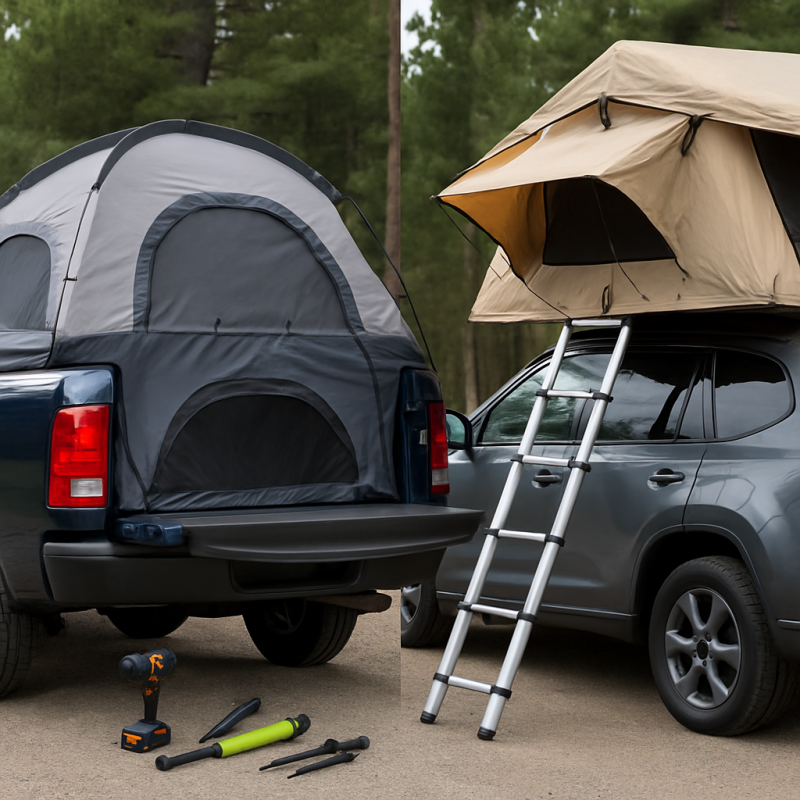
Rooftop tents win on convenience — most hard-shell models open in 60 seconds or less with gas struts doing the heavy lifting. Truck bed tents take 10–20 minutes and require threading poles, staking the tent body, and attaching the rainfly. That said, truck bed tents pack down small enough to toss in a closet.
- Rooftop tent setup: Unlatch 2–4 clips, push the shell open, unfold the ladder. Bedding stays inside between trips — just climb up and sleep.
- Truck bed tent setup: Lay out the tent body, assemble poles, drape over bed rails, secure with clamps or straps, attach rainfly. Similar to setting up a traditional ground tent.
- Takedown: Rooftop tents close in 2–3 minutes. Truck bed tents take 10–15 minutes to break down and stuff into the carry bag.
If you're doing multi-stop road trips where you set up and break camp daily, a rooftop tent saves serious time. For weekend trips where you park at one site for two nights, the setup difference matters less.
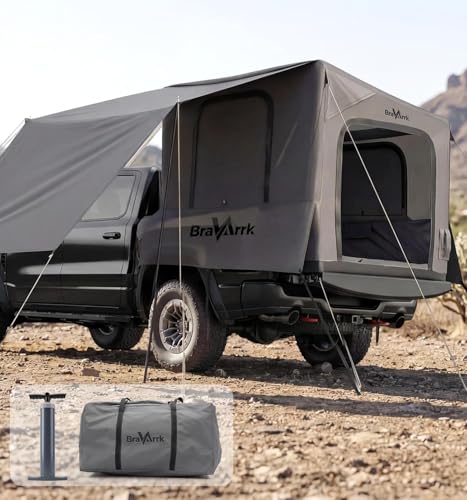
Newer inflatable truck bed tents like the BravArrk Inflatable Truck Bed Tent are closing this gap with 2-minute pump-up designs. They trade pole complexity for an air pump, which is a meaningful improvement if speed matters to you.
One convenience factor people overlook: rooftop tents stay on your truck between trips. You don't have to load or unload anything — just drive to your campsite and pop it open. Truck bed tents must be packed and stored each time, which adds friction to spontaneous trips.
BravArrk Inflatable Truck Bed Tent
An innovative inflatable design that sets up in 2 minutes — no poles required. PU3000mm waterproofing and a detachable awning make this a standout for quick-camp trips.
Check Price On AmazonIf you click this link and buy, we earn a commission at no additional cost to you.
Which Option Is More Comfortable for Sleeping?
Rooftop tents deliver a more comfortable sleep experience right out of the box. The built-in 2–3 inch high-density foam mattress is a major advantage — you're sleeping on a purpose-built platform with no additional purchases needed. Truck bed tents require you to bring your own sleeping pad or air mattress.
- Mattress quality: Rooftop tent mattresses rival what you'd find in a decent guest bedroom. Truck bed tents need a separate truck bed air mattress or sleeping pad to be comfortable.
- Sleeping surface: Rooftop tents have a flat, level platform. Truck beds have wheel wells and corrugated surfaces that can create uneven sleeping — a sleeping platform helps but adds cost and complexity.
- Headroom: Most rooftop tents offer 40–48 inches of interior height. Truck bed tents vary but typically provide 38–42 inches — enough to sit up but not stand.
- Ventilation: Both styles include mesh windows. Rooftop tents benefit from elevation, which catches more breeze and keeps you further from ground moisture.
Temperature is another consideration. Sleeping elevated in a rooftop tent keeps you above ground-level cold air, which can make a 5–10°F difference on chilly nights. However, hard-shell rooftop tents can get hot in summer because the shell absorbs solar heat. Models like the Joyinrute Hard Shell Rooftop Tent address this with insulation layers designed for both cold and hot conditions.
The bottom line: if you want hotel-like convenience, a rooftop tent is hard to beat. If you don't mind adding a good air mattress, a truck bed tent can be nearly as comfortable at a fraction of the cost.
How Does Price Break Down for Each Option?
Truck bed tents are dramatically cheaper — a quality model costs $100–$250, while a rooftop tent runs $800–$3,000+ before you factor in the required rack system. Total cost of ownership is where the difference becomes even more pronounced.
| Cost Category | Truck Bed Tent | Rooftop Tent (Hard Shell) |
|---|---|---|
| Tent | $100–$300 | $1,000–$3,000 |
| Rack System | $0 (not needed) | $200–$800 |
| Mattress/Pad | $30–$100 | $0 (included) |
| Installation | DIY, no tools | DIY or shop ($100–$200) |
| Fuel Economy Impact | Negligible | $200–$500/year |
| Total First-Year Cost | $130–$400 | $1,400–$4,000+ |
The rack system is the hidden cost most people forget. Your truck needs a roof rack or bed rack rated for the tent's weight — typically 120–180 lbs when loaded. Budget rack systems start around $200, but quality options from brands like Prinsu or Uptop Overland run $500–$800+.
- Budget pick (bed tent): The JOYTUTUS Pickup Truck Tent at around $130 delivers solid waterproofing (PU2000mm) with a double-layer design.
- Budget pick (rooftop): The TopAutoGear Soft Shell Rooftop Tent keeps costs under $1,000 with LED lighting and a telescopic ladder included.
- Ongoing costs: Rooftop tents impact fuel economy by 1–3 MPG due to added weight and aerodynamic drag. Over a year of regular driving, that adds up to $200–$500+ in extra fuel.
If you camp 5–10 times a year, a truck bed tent's cost-per-use is unbeatable. Rooftop tents make more financial sense for frequent campers who value the time savings and comfort on 20+ trips annually.
JOYTUTUS Pickup Truck Tent 2.0
A budget-friendly double-layer truck bed tent with PU2000mm waterproofing. Excellent value for campers who want solid rain protection without the premium price tag.
Check Price On AmazonIf you click this link and buy, we earn a commission at no additional cost to you.

What Impact Does Each Tent Have on Your Truck?
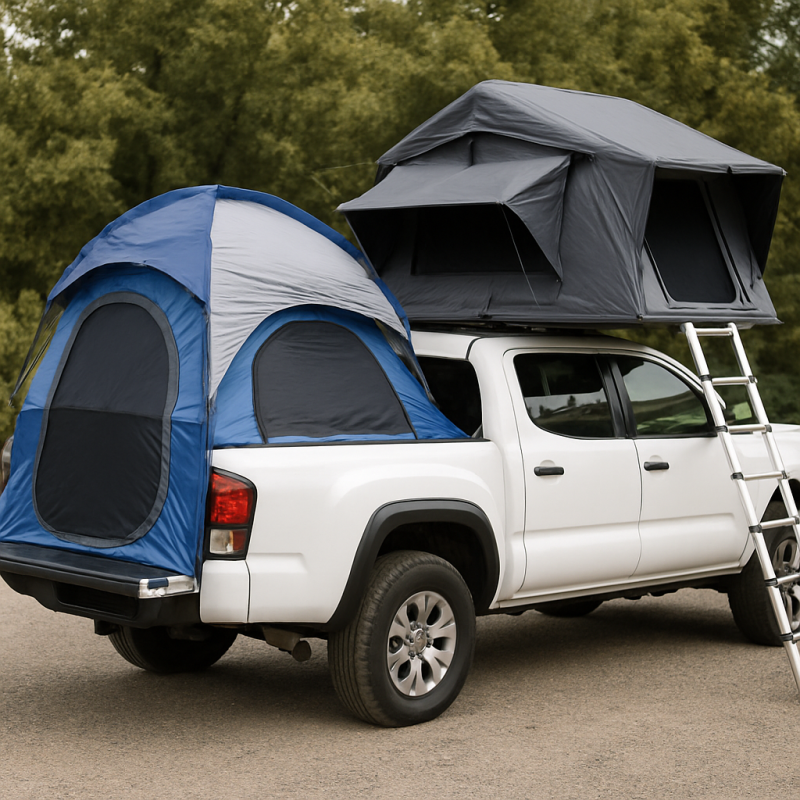
A truck bed tent has virtually zero impact on your vehicle — it weighs under 20 lbs and sits in the bed where your truck is designed to carry weight. A rooftop tent adds 100–180 lbs at the highest point of your vehicle, which noticeably affects driving dynamics, fuel economy, and long-term wear.
- Center of gravity: Rooftop tents raise your truck's center of gravity significantly. You'll feel more body roll in corners and increased sway in crosswinds. This is especially noticeable on lifted trucks.
- Fuel economy: According to testing by MotorTrend, rooftop tents can reduce fuel economy by 1–3 MPG depending on driving speed and tent profile.
- Roof load rating: Check your truck's dynamic roof load rating — this is the weight your roof can carry while driving, typically 150–300 lbs. Many rooftop tents push close to these limits once you add the rack system.
- Bed access: A truck bed tent completely occupies your bed while deployed. If you need to haul gear, lumber, or other cargo to your campsite, a rooftop tent preserves full bed access.
For trucks with a bed canopy or topper, rooftop tents can actually mount on top of the canopy, giving you both enclosed bed storage and elevated sleeping. This is a popular overlanding configuration.
One more thing to consider: garage clearance. A rooftop tent adds 10–14 inches of height to your truck. Many hard-shell models bring the total vehicle height to 8–9 feet, which won't fit in a standard 7-foot garage door. You'll need to either remove the tent for storage or park outside.
Truck bed tents win here decisively. They store in a bag, add no permanent weight or height, and don't affect your daily driving experience in any way.
How Do They Perform in Bad Weather?
Both tent types handle rain well, but rooftop tents have a clear advantage in extreme weather and four-season use. Being elevated keeps you out of puddles and mud, and hard-shell models shed rain and snow more effectively than fabric truck bed tents.
- Rain protection: Quality truck bed tents rate PU2000–3000mm for waterproofing, which handles moderate to heavy rain. Rooftop tents typically exceed PU3000mm with sealed seams and rigid shells that prevent pooling.
- Wind resistance: Truck bed tents are more sheltered since they sit low in the bed — the cab and bed walls block wind from three sides. Rooftop tents catch more wind due to their elevated position, though hard shells handle gusts better than soft shells.
- Snow: Hard-shell rooftop tents excel in snow — the rigid top sheds snow naturally and provides insulation. Truck bed tent fabric can sag under snow weight.
- Ground moisture: Rooftop tents keep you completely above ground moisture, dew, and puddles. Truck bed tents benefit from the bed's elevation but can still experience condensation on the tent floor.
For three-season camping in moderate climates, both options work fine. Models like the PU3000mm Truck Bed Tent offer excellent rain protection that rivals many rooftop tents at a fraction of the price.
For four-season and cold-weather camping, rooftop tents are the better choice. Hard-shell models with insulated panels maintain interior warmth more effectively, and you're sleeping above the coldest air layer near the ground. The Adventurer Pro Rooftop Tent is built specifically for four-season use with insulated walls and a replaceable rain fly.
Adventurer Pro Rooftop Tent Hard Shell
A feature-packed four-season hard-shell rooftop tent with USB outlets, side awning, and luggage racks. Built for serious overlanders who camp year-round.
Check Price On AmazonIf you click this link and buy, we earn a commission at no additional cost to you.

Which Is Better for Different Camping Styles?
Your camping style should drive your decision more than any single feature. A truck bed tent is ideal for occasional campers and budget-conscious adventurers, while a rooftop tent suits frequent overlanders and long-trip travelers who prioritize convenience.
| Camping Style | Best Choice | Why |
|---|---|---|
| Weekend warrior (5–10 trips/year) | Truck Bed Tent | Low cost, easy storage, no vehicle mods needed |
| Overlanding / road trips | Rooftop Tent | Fast setup at each stop, bed stays free for gear |
| Hunting / fishing basecamp | Truck Bed Tent | Lightweight, pack-in/pack-out, no rack needed |
| Family camping (2+ people) | Rooftop Tent | More space, built-in mattress, better for kids |
| Solo camping | Truck Bed Tent | Overkill to spend $1,500+ for one person |
| Year-round / winter camping | Rooftop Tent | Better insulation, elevated from snow/moisture |
| Daily driver truck | Truck Bed Tent | No permanent mods, no MPG loss, fits in garage |
If you haul equipment regularly, consider how each option affects your cargo situation. A rooftop tent leaves your bed completely open for cargo nets, storage drawers, and other gear. A truck bed tent takes over the entire bed — you'll need to plan around that or bring a separate vehicle for cargo.
Couples and small families often find rooftop tents worth the investment. The built-in mattress eliminates arguments about sleeping pads, and the elevated sleeping position gives a sense of security in bear country or areas with ground-level critters.
For solo campers and occasional users, the math strongly favors a truck bed tent. The waterproof truck bed tent with awning gives you a protected sleeping space plus an expanded awning area for cooking and hanging out — all for under $200.
WildFinder Hard Shell Rooftop Tent
A well-built hard-shell rooftop tent that fits trucks, SUVs, and Jeeps. Sleeps 2–3 people comfortably and offers quick pop-up deployment for fast camp setup.
Check Price On AmazonIf you click this link and buy, we earn a commission at no additional cost to you.

What Should You Consider Before Buying?
Before committing to either option, run through this checklist to make sure your choice fits your truck, your budget, and your camping habits. The wrong pick leads to buyer's remorse — especially with rooftop tents, where returns are complicated by weight and size.
- Bed size compatibility: Truck bed tents come in specific sizes — short bed (5.5'), standard (6.5'), and long bed (8'). Measure your bed carefully. Models like the PU3000mm tent for 6.4–6.7 ft beds are sized for standard beds specifically.
- Roof load rating: Check your truck's owner's manual for the dynamic roof load capacity. This is NOT the static rating — it's the weight your roof safely carries while driving. Most full-size trucks handle 150–300 lbs dynamically.
- Garage height: Measure your garage opening. A rooftop tent adds 10–14 inches. If your lifted truck already clears by inches, a rooftop tent may not fit.
- Camping frequency: If you camp fewer than 10 times a year, a truck bed tent's cost-per-use makes more sense. Over 15 trips annually, a rooftop tent's convenience pays for itself in time saved.
- Solo vs. partner: Both options sleep two, but rooftop tents designed for 2–3 people offer more elbow room. Hard-shell models like the WildFinder Hard Shell Rooftop Tent give couples legitimate space to move around.
Also consider your truck's existing setup. If you already have a bed liner installed, a truck bed tent sits directly on it with no modifications. Rooftop tents require a compatible rack — not all aftermarket racks fit all tent mounting systems.
Finally, think about resale value. Quality rooftop tents hold their value well on the used market — you can typically recover 50–70% of your investment. Truck bed tents depreciate quickly and aren't worth reselling, but at $100–$200, that's not a major concern.
Related Articles
- Best Truck Bed Air Mattresses for Camping — Truck bed tents require a separate sleeping surface — this review covers the best air mattress options
- Best Truck Bed Sleeping Platforms for Camping — Sleeping platforms solve the uneven truck bed surface problem for bed tent users
- Best Truck Bed Canopies and Toppers — Canopies can serve as a base for mounting rooftop tents while keeping bed storage
- Best Truck Bed Cargo Nets — Rooftop tents leave the bed open for cargo organization solutions
- Best Truck Bed Liners for Protection — Bed liners provide a compatible surface for mounting truck bed tents
Conclusion
Recommended Products
Napier Backroadz Truck Tent
The best-selling truck bed tent on the market with a proven 10-minute setup. Fits most full-size trucks and includes a full rainfly for weather protection.
Check Price On AmazonIf you click this link and buy, we earn a commission at no additional cost to you.
JOYTUTUS Pickup Truck Tent 2.0
A budget-friendly double-layer truck bed tent with PU2000mm waterproofing. Excellent value for campers who want solid rain protection without the premium price tag.
Check Price On AmazonIf you click this link and buy, we earn a commission at no additional cost to you.
Adventurer Pro Rooftop Tent Hard Shell
A feature-packed four-season hard-shell rooftop tent with USB outlets, side awning, and luggage racks. Built for serious overlanders who camp year-round.
Check Price On AmazonIf you click this link and buy, we earn a commission at no additional cost to you.
WildFinder Hard Shell Rooftop Tent
A well-built hard-shell rooftop tent that fits trucks, SUVs, and Jeeps. Sleeps 2–3 people comfortably and offers quick pop-up deployment for fast camp setup.
Check Price On AmazonIf you click this link and buy, we earn a commission at no additional cost to you.
BravArrk Inflatable Truck Bed Tent
An innovative inflatable design that sets up in 2 minutes — no poles required. PU3000mm waterproofing and a detachable awning make this a standout for quick-camp trips.
Check Price On AmazonIf you click this link and buy, we earn a commission at no additional cost to you.
Frequently Asked Questions
Can you use a truck bed tent with a tonneau cover?
How much weight does a rooftop tent add to your truck?
Are truck bed tents waterproof?
Can you stand up inside a rooftop tent?
Do rooftop tents damage your truck's roof?
How long do truck bed tents last?
Can you drive with a truck bed tent set up?
Is a rooftop tent worth the money over a truck bed tent?
Affiliate Disclosure: This article contains affiliate links. If you purchase through these links, we may earn a commission at no extra cost to you.