Sleeping in a Truck Bed: Laws, Safety, and Tips
Whether you're on a cross-country road trip, camping off-grid, or just trying to save on hotel costs, sleeping in your truck bed sounds like a practical solution. But before you throw a sleeping bag in the back and call it a night, you need to understand the legal landscape. The short answer is that no federal law makes it illegal to sleep in a truck bed, but the reality is far more nuanced. State laws, city ordinances, parking regulations, and even homeowner association rules can turn a simple overnight stay into a costly ticket. This guide breaks down exactly where you can and can't sleep in your truck bed, how to stay on the right side of the law, and how to set up a safe, comfortable sleeping arrangement.
Key Takeaways
- No federal law prohibits sleeping in your truck bed, but state and local ordinances vary widely and can result in fines.
- Most states allow sleeping in your vehicle at rest stops for limited periods, typically 8-12 hours maximum.
- Private property with permission, designated campgrounds, and BLM land are the safest legal options for overnight truck bed sleeping.
- Passenger safety laws in many states prohibit riding in a truck bed while the vehicle is moving, but sleeping while parked is a separate legal question.
- Proper setup with a quality air mattress, canopy or tent, and awareness of local carbon monoxide and ventilation risks is essential for safe truck bed sleeping.
Is It Legal to Sleep in a Truck Bed?
There is no federal law that specifically prohibits sleeping in a truck bed while the vehicle is parked. However, legality depends entirely on where you park, which state you're in, and local ordinances that govern overnight parking and camping.
The legal question actually involves three separate issues:
- Vehicle habitation laws: Some cities have anti-camping or vehicle habitation ordinances that make it illegal to use any vehicle as a dwelling, even temporarily.
- Parking restrictions: Even if sleeping in your truck is technically legal, parking overnight in restricted areas (no-parking zones, private lots, residential streets) can get you ticketed or towed.
- Public intoxication or DUI concerns: In some states, sleeping in a vehicle while intoxicated — even with the engine off — can result in a DUI charge if keys are accessible.
The distinction between sleeping and camping matters legally. Many jurisdictions define camping as setting up any sleeping accommodation, cooking equipment, or shelter. Simply reclining in your truck cab might be treated differently than laying out a full sleeping platform with bedding in your truck bed.
It's also important to separate moving versus stationary laws. Most states that restrict truck bed occupancy are focused on passengers riding in an open bed while the vehicle is in motion — a safety issue governed by state passenger restraint laws. Sleeping in a parked truck bed is a completely different legal category and is generally more permissive.
The safest approach is to check local laws before you park. A quick call to the local non-emergency police line can save you from a 2 AM knock on your tailgate.
Which States Restrict Sleeping in Vehicles?
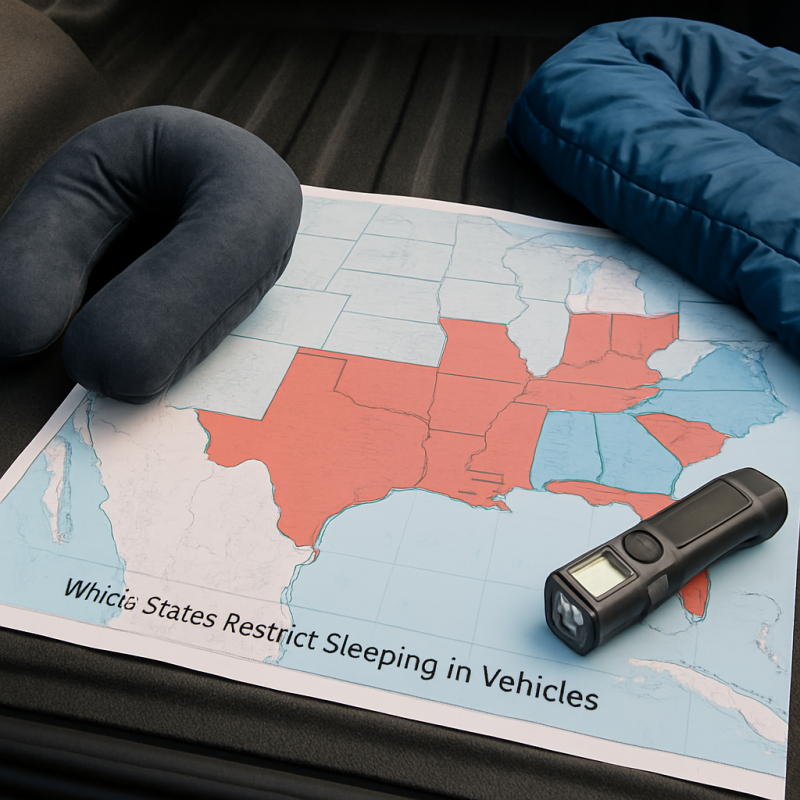
Most states do not have blanket bans on sleeping in your vehicle, but several have laws that can affect truck bed sleepers. The restrictions typically come from city-level ordinances rather than state statutes.
Here's how states generally break down:
| Category | States | Key Rules |
|---|---|---|
| Generally Permissive | Montana, Wyoming, Nevada, Idaho, Oregon | Few restrictions; rest stops allow overnight stays |
| Rest Stop Limits | California, Texas, Florida, Ohio, Virginia | Rest stops allow 8-12 hours max; city rules vary |
| Strict Local Ordinances | Colorado, Washington, Georgia, Hawaii | Many cities ban vehicle habitation; state rest stops still okay |
| DUI Risk While Sleeping | Arizona, Pennsylvania, New Jersey, Michigan | Sleeping in vehicle with keys accessible may trigger DUI laws |
Some specific examples worth noting:
- California: No state law prohibits sleeping in your vehicle, but cities like Los Angeles and San Francisco have enacted vehicle habitation ordinances. In 2024, the Governor's office signed legislation giving cities more enforcement tools.
- Texas: Generally permissive at the state level. Rest stops allow stays up to 24 hours. Many Walmart and Cracker Barrel locations informally permit overnight parking.
- Colorado: State rest areas allow overnight stays, but Denver and Boulder have strict anti-camping ordinances that include vehicles.
- Florida: Rest stops allow up to 3 hours. Longer stays require designated campgrounds or private property.
The trend across the country has been toward more restrictions, particularly in urban areas dealing with homelessness concerns. Always verify current local laws — what was legal last year may not be today.
Where Can You Legally Park Overnight?
The safest legal options for overnight truck bed sleeping are designated campgrounds, BLM land, national forests, and private property with permission. Each option has different rules, costs, and comfort levels.
Here are your best bets ranked by reliability:
- Established campgrounds: State parks, national parks, and private campgrounds are always legal. Costs range from $10-$45/night. Many have restrooms and water access.
- BLM (Bureau of Land Management) land: Free dispersed camping is allowed on most BLM land for up to 14 days. This covers roughly 245 million acres across western states.
- National forests: The USDA Forest Service allows dispersed camping in most national forests for free, typically up to 14 days within a 30-day period.
- Rest stops and welcome centers: Most states allow stays of 8-12 hours. Some states like Oregon and Texas are more generous; others like Florida limit stays to 3 hours.
- Walmart and Cracker Barrel parking lots: Many locations informally allow overnight parking, but policies vary by store and local ordinance. Always ask the manager first.
- Truck stops: Pilot, Flying J, Love's, and TA truck stops generally welcome overnight parking. These also offer showers and food.
- Casino parking lots: In many states, casinos allow free overnight parking as a courtesy to potential customers.
Apps like iOverlander, FreeRoam, and Campendium are invaluable for finding verified free and legal overnight spots. These community-driven platforms include recent user reviews confirming whether a spot is still available and safe.
When parking on any public land, follow Leave No Trace principles. Pack out all trash, avoid setting up elaborate camp structures that draw attention, and keep noise to a minimum. The more discreet your setup, the less likely you are to have issues — even in areas where sleeping in your truck bed is technically legal.
What Are the Safety Risks of Sleeping in a Truck Bed?
The biggest safety risks when sleeping in a truck bed are carbon monoxide poisoning, exposure to weather, and personal security. Understanding these risks and mitigating them is more important than the legal question for most truck campers.
- Carbon monoxide (CO) poisoning: Never run your engine while sleeping in the bed, even with a canopy. CO is odorless and can accumulate in enclosed spaces. If you use a truck bed canopy or topper, ensure adequate ventilation with at least two openings for cross-airflow.
- Hypothermia and heat exposure: Truck beds offer zero insulation. Metal beds radiate cold in winter and absorb heat in summer. A quality sleeping pad or air mattress provides critical insulation from the bed surface.
- Falls and injuries: Open truck beds with no canopy pose a fall risk, especially if you move during sleep. Tailgate locks and bed rail padding can reduce this risk.
- Personal security: Sleeping in an open truck bed makes you visible and vulnerable. A canopy, tent, or tinted camper shell provides both privacy and security.
For comfortable and safe sleeping, invest in proper gear. A truck bed air mattress designed specifically for short-bed pickups makes a huge difference in sleep quality and insulation from the metal bed surface. These are cut to fit around wheel wells, eliminating the awkward gaps you get with standard air mattresses.
Additional safety precautions include:
- Park on level ground: A sloped surface means you'll roll all night and may stress your tailgate.
- Lock your doors and tailgate: Even if you're sleeping in the bed, lock your cab to protect valuables.
- Tell someone your location: Share your GPS coordinates with a friend or family member.
- Keep a flashlight and phone accessible: Not buried under gear at the bottom of your bed.
hufaut Camping Pickup Truck Bed Air Mattress
Designed specifically for 5.5-5.8ft short truck beds, this thickened air mattress fits around wheel wells for a full sleeping surface. Essential for anyone planning to sleep in their truck bed overnight.
Check Price On AmazonIf you click this link and buy, we earn a commission at no additional cost to you.

How Do You Set Up a Truck Bed for Sleeping?
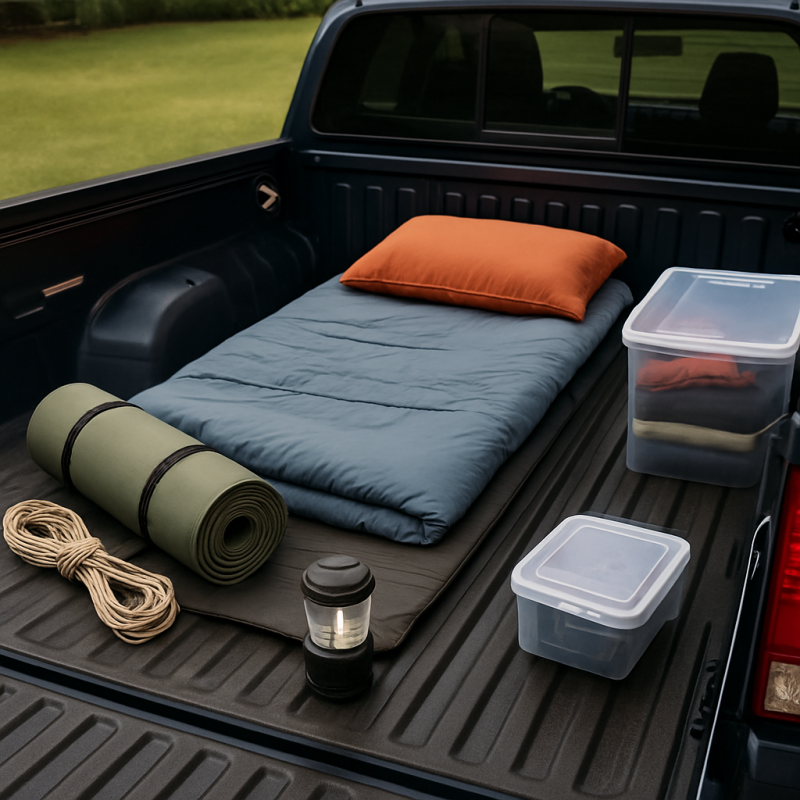
Setting up a truck bed for sleeping requires three essentials: a flat sleeping surface, weather protection, and proper insulation. The right setup turns a bare truck bed into a surprisingly comfortable sleeping space.
Start with the sleeping surface:
- Truck bed air mattress: Purpose-built mattresses fit around wheel wells and fill the bed completely. These are the most popular option for occasional truck camping. Check our roundup of top truck bed air mattresses for detailed comparisons.
- Sleeping platform: A plywood or aluminum platform creates a flat, elevated surface with storage underneath. This is the best option for frequent truck campers who want a permanent setup.
- Truck bed mat + sleeping pad: A rubber bed mat topped with a camping sleeping pad is the budget-friendly approach. The mat protects your pad from bed ridges and bolt heads.
Next, address weather protection:
- Truck bed tent: Attaches to your bed rails and creates an enclosed sleeping space with ventilation. Works great with both short and standard beds. Browse the best truck bed tents to find one that fits your truck.
- Camper shell or topper: A permanent or semi-permanent hard shell offers the best weather protection, security, and stealth.
- Tonneau cover: Some hard tri-fold or retractable covers provide enough clearance to sleep under, though headroom is very limited.
Don't forget the details that make or break your sleep quality:
- LED strip lights: Battery-powered strips give you interior lighting without draining your truck battery.
- Window coverings: If using a topper, reflective window covers provide privacy and temperature control.
- Ventilation fan: A small battery-powered fan prevents condensation buildup inside enclosed setups.
- Bed liner or mat: Protects both your truck bed and your gear. A quality truck bed mat provides cushioning and prevents gear from sliding.
F-LptStor F-150 Truck Bed Tie Down Anchors
Secure your sleeping platform, air mattress, or storage bins so nothing shifts during the night. Essential for keeping your truck bed sleeping setup stable and safe.
Check Price On AmazonIf you click this link and buy, we earn a commission at no additional cost to you.

Can You Get a DUI Sleeping in Your Truck?
Yes, in many states you can receive a DUI charge for sleeping in your vehicle while intoxicated — even if the engine is off and you're in the truck bed, not the cab. This is one of the most misunderstood legal risks of sleeping in a truck.
The key legal concept is "physical control" of the vehicle. States define this differently:
| Standard | States | What It Means |
|---|---|---|
| Strict Physical Control | Arizona, Pennsylvania, Ohio | Having keys accessible = physical control, even if engine is off |
| Intent-Based | California, New York, Illinois | Prosecution must prove intent to drive; sleeping suggests no intent |
| Engine Must Be Running | Texas, Montana | Vehicle must be operational for DUI to apply |
| Location-Based | Oregon, Washington | Being in the driver's seat matters; truck bed may not qualify |
Sleeping in the truck bed rather than the cab can actually work in your favor legally. Many courts have ruled that being in the cargo area demonstrates a lack of intent to operate the vehicle. However, this is not a guaranteed defense.
If you plan to drink and sleep in your truck, follow these precautions:
- Put keys in the glove box or under a seat: Not in your pocket or the ignition.
- Sleep in the bed, not the cab: Physical distance from the steering wheel helps establish you weren't planning to drive.
- Don't start the engine: Even to run heat or AC. Use blankets and sleeping bags instead.
- Document your intent: A text to a friend saying "sleeping in my truck tonight, driving home tomorrow" can serve as evidence of responsible planning.
According to the National Highway Traffic Safety Administration, choosing to sleep it off rather than drive is always the safer decision — but know your state's laws so your responsible choice doesn't result in an unexpected charge.
What Are the Best Practices for Stealth Truck Camping?
Stealth truck camping means sleeping in your truck bed without drawing attention from law enforcement, property owners, or passersby. Even in areas where it's technically legal, being discreet avoids confrontations and complaints.
Follow these proven stealth camping practices:
- Arrive late, leave early: Pull into your spot after 9-10 PM and leave by 6-7 AM. The less time you're stationary, the less likely anyone notices.
- Keep your setup minimal: Don't set up chairs, tables, grills, or awnings. The moment your truck looks like a campsite, you've crossed from parking to camping in most ordinances.
- Block all light: Interior lights visible from outside signal that someone is living in the vehicle. Use blackout curtains or reflective window covers.
- Stay quiet: No music, no generators, no loud conversations after dark.
- Keep your truck clean and presentable: A well-maintained truck parked normally draws far less attention than one surrounded by gear and tarps.
Location selection is critical for stealth camping:
- Mixed-use areas: Park near businesses that have 24-hour activity (hospitals, hotels, 24-hour gyms). Your truck blends in with employee and visitor vehicles.
- Industrial areas: Light industrial zones with trucks and work vehicles are ideal — your truck is just another vehicle in the lot.
- Big box store parking lots: Park toward the outer edges, away from entrances but not in an isolated corner that looks suspicious.
- Rotate locations: Never park in the same spot two nights in a row. Repetition is what triggers complaints.
Keep a go-bag ready so you can leave quickly if asked. Have your keys, wallet, and phone accessible — not buried in your sleeping setup. If a security guard or officer approaches, be polite, cooperative, and ready to move. Most encounters end with a simple request to relocate, not a ticket.
For organizing your gear efficiently, a truck bed drawer system keeps everything accessible without the clutter that draws unwanted attention.
Rough Country Slide-Out Truck Bed Cargo Tray
Keeps your camping gear organized and accessible from the tailgate. Slides out for easy loading and stows flat to leave room for your sleeping setup above.
Check Price On AmazonIf you click this link and buy, we earn a commission at no additional cost to you.

Do You Need a Permit or Registration to Sleep in Your Truck?
In most cases, no special permit is needed to sleep in your truck bed on public land or in legal parking areas. However, certain locations and extended stays do require permits or registration.
Here's when permits come into play:
- National park campgrounds: Always require a campsite reservation or permit. Sleeping in your truck bed at a designated site is fine; sleeping in a random pullout within park boundaries may not be.
- State parks: Most require day-use or camping fees, even if you're sleeping in your vehicle rather than a tent.
- BLM dispersed camping: Generally free and no permit needed for stays under 14 days. Some high-traffic BLM areas (like Quartzsite, Arizona or Moab, Utah) have specific regulations during peak seasons.
- National forests: Free dispersed camping is usually allowed, but some ranger districts require fire permits, even if you don't plan to have a fire.
- Urban areas: Some cities have implemented overnight parking permit systems for residents. Check if you're parking in a permit-required zone.
There's also the question of vehicle registration and insurance. Your standard auto insurance covers your truck whether you're driving it or sleeping in it. However, if you've made significant modifications — like a permanent sleeping platform, electrical system, or plumbing — some insurance companies may classify your vehicle differently.
For extended truck living (more than occasional camping), some states may consider your truck a recreational vehicle if it has permanent sleeping and cooking facilities. This could trigger RV registration requirements, though enforcement is rare for simple truck bed setups.
The bottom line: for occasional overnight stays, your regular driver's license, registration, and insurance are all you need. Just make sure you're parked in a legal location and following any posted time limits or campground rules.
Related Articles
- Best Truck Bed Sleeping Platforms for Camping — Discusses sleeping platform options as an alternative to air mattresses for truck bed camping setups
- Best Truck Bed Canopies and Toppers — Covers canopy and topper options that provide weather protection and privacy for sleeping in a truck bed
- Best Truck Bed Air Mattresses for Camping — Reviews the top air mattresses designed specifically for truck beds, essential for comfortable truck bed sleeping
- Best Truck Bed Tents for Camping — Reviews truck bed tents that provide enclosed sleeping spaces with ventilation for truck camping
- Best Truck Bed Mats for Every Pickup — Covers truck bed mats that provide cushioning and surface protection for sleeping setups
- Best Truck Bed Drawers for Storage — Reviews drawer systems that help organize gear for stealth truck camping without visible clutter
Conclusion
Recommended Products
hufaut Camping Pickup Truck Bed Air Mattress
Designed specifically for 5.5-5.8ft short truck beds, this thickened air mattress fits around wheel wells for a full sleeping surface. Essential for anyone planning to sleep in their truck bed overnight.
Check Price On AmazonIf you click this link and buy, we earn a commission at no additional cost to you.
Rough Country Slide-Out Truck Bed Cargo Tray
Keeps your camping gear organized and accessible from the tailgate. Slides out for easy loading and stows flat to leave room for your sleeping setup above.
Check Price On AmazonIf you click this link and buy, we earn a commission at no additional cost to you.
F-LptStor F-150 Truck Bed Tie Down Anchors
Secure your sleeping platform, air mattress, or storage bins so nothing shifts during the night. Essential for keeping your truck bed sleeping setup stable and safe.
Check Price On AmazonIf you click this link and buy, we earn a commission at no additional cost to you.
Frequently Asked Questions
Is it illegal to sleep in your truck at a rest stop?
Can you sleep in a truck bed with a topper?
Is sleeping in your truck considered camping?
Can you get a ticket for sleeping in your truck overnight?
Where is the safest place to sleep in a truck bed?
Do you need a special mattress for a truck bed?
Is it safe to sleep in an open truck bed?
Can you sleep in your truck bed at Walmart?
Affiliate Disclosure: This article contains affiliate links. If you purchase through these links, we may earn a commission at no extra cost to you.